Research School for Economic and Social History

Category: Agenda

  • European Social Science History Conference (ESSHC) 2025

    European Social Science History Conference (ESSHC) 2025

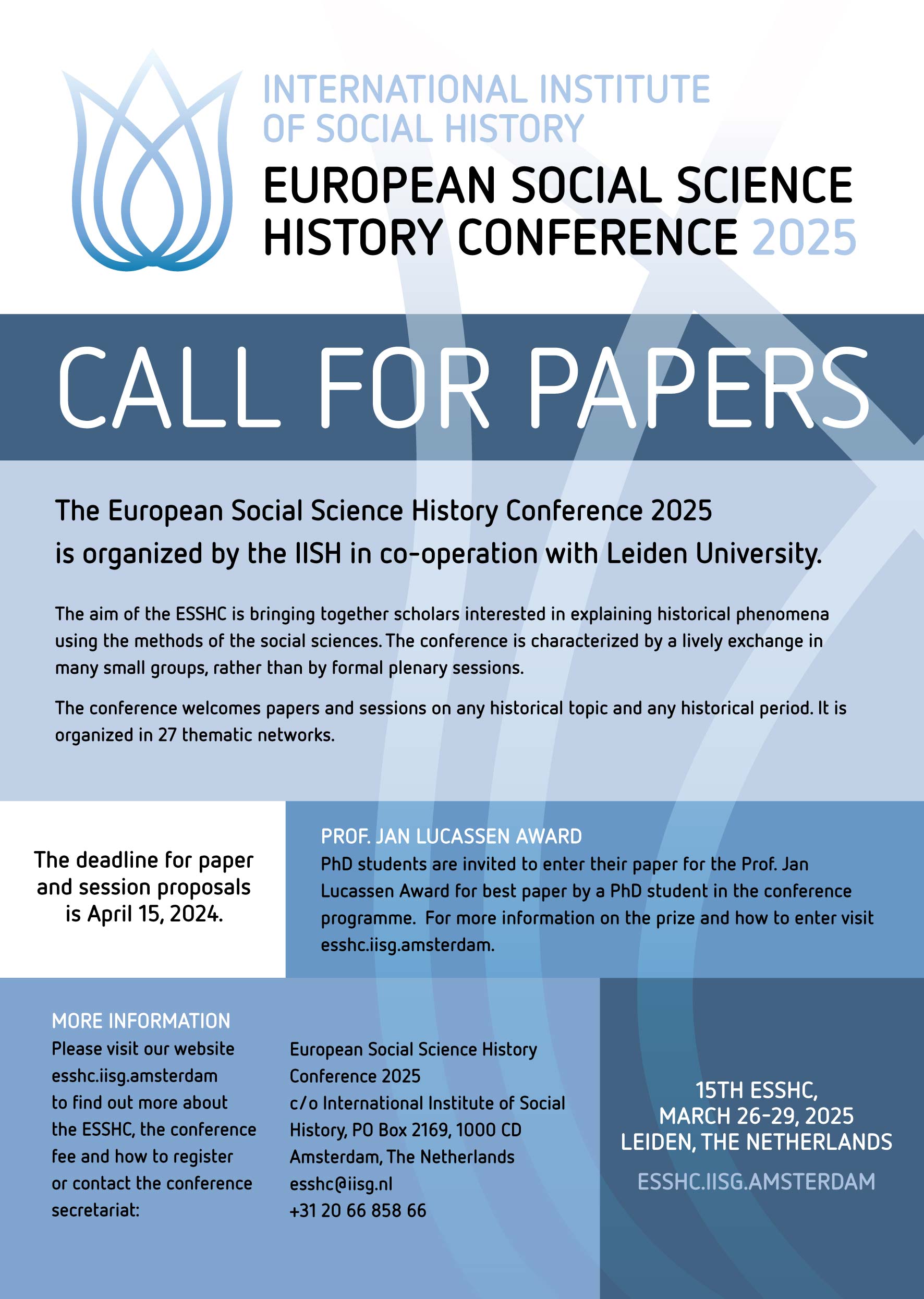
    The 15th European Social Science History Conference (ESSHC) 2025 will take place on 26-29 March 2025 in Leiden, organised by the International Institute for Social History in co-operation with Leiden University.

    The aim of the ESSHC is bringing together scholars interested in explaining historical phenomena using the methods of the social sciences. The conference is characterised by a lively exchange in many small groups, rather than by formal plenary sessions. The conference welcomes papers and sessions on any historical topic and any historical period. It is organized in 27 thematic networks; the organisers strongly encourage interdisciplinary and international sessions.

    Deadline for submission of paper and sessions proposals was 15 April 2024.

    MORE INFO

  • Jaarcongres De Moderne Tijd 2024

    Jaarcongres De Moderne Tijd 2024

    ~ because of scope, in Dutch only ~

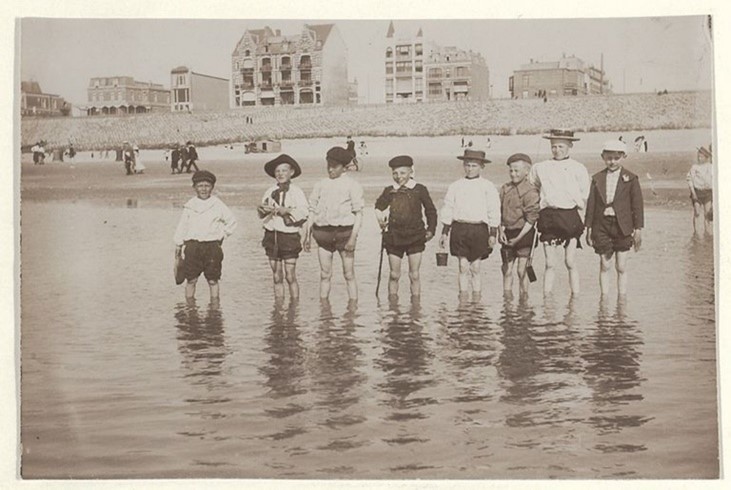
    Op 22 maart 2024 vindt het jaarcongres van De Moderne Tijd plaats over het thema ‘Water: beleving, beheer, beeldvorming in de lange negentiende eeuw’.

    Water is een grillig en fascinerend fenomeen in de lange negentiende eeuw. De strijd tegen het water werd onderdeel van de Nederlandse nationale identiteit en beeldvorming. Het water bepaalde de vormgeving van het landschap of bleek een essentiële voorziening voor de stedelijke ontwikkeling. Hendrik Willem Mesdag hield van de woeste branding aan de kust, Jan Voerman van het dromerige rivierenlandschap, Gerrit Willem Dijsselhof van het schilderachtige aquarium, Joseph Coosemans van de contrasten tussen heide en moeras.

    Het congres van de Werkgroep de Moderne Tijd is in 2024 gewijd aan water: aan de beleving, het beheer en de beeldvorming in de periode 1780-1940. Wat waren de wateropgaven in deze lange negentiende eeuw? Hoe bepaalde het water de economie, de handel en het toerisme? Op welke manier was het een bron van inspiratie voor ingenieurs, wetenschappers of kunstenaars? Kortom, welke rol speelde het water in de cultuur en identiteit van de snel veranderende samenleving van de lage landen tijdens de lange negentiende eeuw? Aan de hand van deze vragen beoogt het congres stil te staan bij de veelzijdige culturele betekenis van water en de maatschappelijke, wetenschappelijke en artistieke vragen in de Lage Landen.

    Aanmelden kan tot uiterlijk 13 maart 2024 per e-mail via Marjet Brolsma (Universiteit van Amsterdam). Voor deelname geldt een bijdrage, voor studenten geldt gereduceerd tarief.

    MEER INFO EN PROGRAMMA (PDF)
  • Historians’ Days / Historicidagen 2024 (Maastricht University)

    Historians’ Days / Historicidagen 2024 (Maastricht University)

    The organisers of the 2024 Historians’ Days (in Dutch: Historicidagen) call for proposals. This event is jointly organised by the Royal Netherlands Historical Society (KNHG), Maastricht University, Open University and Fontys University of Applied Sciences on 22-24 August 2024, and are meant for everyone interested in history, professionally or otherwise.

    The Historians’ Days 2024 evolve around the theme of ‘Undisciplined History’, and actively promote diversity within participants, audience, program, stories, methods and presentations.The event showcases the many diverse and dynamic ways of doing history. Through a wide spectrum of lectures, debates and workshops, the Historians’ Days tackles issues and challenges on the frontline of historical research and public debates. Keywords of the conference include networking, inspiration, orientation, career and relaxation.

    Proposals for contributions in either disciplined or undisciplined form should be submitted ultimately 31 January 2024.

    MORE INFO

  • PhD Defence Posthumus alumna Hannah Fluit

    PhD Defence Posthumus alumna Hannah Fluit

    On 8 February 2024, Posthumus alumna Hannah Fluit will defend her thesis ‘Piety, poverty, and politics. The dynamics of Vincentian charity in modern belgium (1840-1945)’. The defence will be at the Hanna Ahrend Institute in Mechelen. Promotores are Professor Kaat Wils (KU Leuven) and Professor Bert De Munck (University of Antwerp), with Professor Patrick Loobuyck (University of |Antwerp) as co-promotor. Focusing on ‘Vincentian’ charities for lay women and men, Hannah’s study explores the intricate relationship between the spiritual and social objectives of charity in Belgium. Spanning from the early 1840s to the tumultuous era of the Second World War, the investigation traces the Vincentian organization’s development amid societal transformations

    The Posthumus staff wishes Hannah a succesful defence!

    MORE INFO

  • Financial, Economic and Business History Summer School (University of Groningen)

    Financial, Economic and Business History Summer School (University of Groningen)

    The Financial, Economic and Business History (FEB-HIS) Summer School for PhD students and Postdocs will take place in Groningen from Monday 24 June to Friday 28 June 2024. It is organised by the Faculty of Economics and Business of the University of Groningen (UG) and made possible thanks to funding by NWO, the Groningen Growth and Development Centre and the European Historical Economics Society. The FEB-HIS Summer School is coordinated by Posthumus fellow Amaury de Vicq and Posthumus PhD Thalassa de Waal

    The school’s main aim is to offer PhD students and Postdocs the opportunity to develop core research skills, ranging from presenting their research project, receiving feedback, providing commentary on the work of their peers, and moderating each other’s sessions. Participants will receive feedback on their presentations from leading scholars in the field. Moreover, these scholars will deliver keynote speeches on the latest developments in financial, economic and business history, shedding light on the digitization of historical data and innovative research methodologies. Moreover, students will receive guidance on publishing their work from (former) journal editors and gain valuable insights into academic career prospects. In celebration of the third female (and first in economic history) Noble Memorial Prize winner in Economic Sciences, Claudia Goldin, we will also pay particular attention to women in academia.

    Confirmed speakers are Posthumus board members Jutta Bolt (University of Groningen & Lund University) and Abe de Jong (University of Groningen & Monash University), Posthumus alumni Sandra de Pleijt (Wageningen University) and Selin Dilli (Utrecht University) as well as Rui Pedro Esteves (Graduate Institute of International and Development Studies in Geneva), and Sibylle Lehmann-Hasemeyer (University of Hohenheim).

    Deadline for applications is 15 March 2024. A registration fee for admitted participants applies.

    MORE INFO

  • Public lecture Professor Nigel Penn on ‘Rough Treatment: Slavery and unfree labour in the Cape Colony 1750-1900′

    Public lecture Professor Nigel Penn on ‘Rough Treatment: Slavery and unfree labour in the Cape Colony 1750-1900′

    On 9 January 2024, Professor Nigel Penn (University of Cape Town) will deliver the public lecture ‘Rough Treatment: Slavery and unfree labour in the Cape Colony 1750-1900’. This lecture is organised by the multidisciplinary research group Colonial Relations and Structures at Radboud University.

    In this public lecture, visiting scholar Nigel Penn from the University of Cape Town will present his research on the Khoisan and Slave Revolt of 1801, exploring how race, class and gender oppressions combined to provoke a major anti-colonial uprising in the Cape Colony. Afterwards you are cordially invited to join the opening of the travelling South African exhibition ‘Fugitives’ on the ground floor of the Erasmus Building. This exhibition is a unique and innovative research and art hybrid collaboration, in which pracademic and forensic facial imaging specialist Kathryn Smith (Stellenbosch University) reconstructed portraits of 19th-century runaway enslaved people together with historians.

    Attendance is free of charge, prior registration however is requested.

    REGISTER

  • FRESH Workshop ‘Institutions, human capital, and long-term development: lessons from pre-modern Europe’ (UC Louvain)

    FRESH Workshop ‘Institutions, human capital, and long-term development: lessons from pre-modern Europe’ (UC Louvain)

    On 24 and 25 June 2024, LIDAM at UCLouvain will host a FRESH workshop on ‘Institutions, human capital, and long-term development: lessons from pre-modern Europe’. The purpose is to create the opportunity for graduate students and early-stage researchers to present and discuss their work in an environment especially focused on constructive feedback and support. The keynote speakers for this meeting will be Joel Mokyr, Professor of Economics and History at Northwestern University, and Nico Voigtländer, Professor of Economics at UCLA Anderson.

    This meeting is organized by David de la Croix (LIDAM, UCLouvain) and Paula Gobbi (ECARES, ULB) in association with the Frontier Research in Economic and Social History series (FRESH-organizer Sandra de Pleijt). This meeting is made possible thanks to funding made available by the ERC grants of the organizers and the European Historical Economics Society.

    Researchers interested in presenting should send an abstract of max. 500 words and/or a full paper, as well as a brief (1-2 page) CV by 31 January 2024. Detailed instructions are to be found in the full info via the button below.

    FULL INFO

  • PhD Defence Posthumus alumna Eva van der Heijden

    PhD Defence Posthumus alumna Eva van der Heijden

    On 21 March 2024, Posthumus alumna Eva van der Heijden successfully defended her thesis ‘Educational Endeavors: Children of immigrants in education in the Netherlands, 1980-2020’ at Leiden University.

    Promotor was Professor Leo Lucassen (Leiden University), co-promotor Professor Helga de Valck ( Netherlands Interdisciplinary Demographic Institute, University of Groningen).

    The N.W. Posthumus staff congratulates Eva with this achievement!

  • PhD Defence Posthumus alumnus Damion Bunders

    PhD Defence Posthumus alumnus Damion Bunders

    On 15 March 2024, Posthumus alumnus Damion Bunders will defend his thesis ‘Gigs of their Own: can platform cooperatives become resilient?’ at the Erasmus Research Institute of Management of Erasmus University Rotterdam.

    Damion’s dissertation is about platform cooperatives as an alternative form of organisation where gig workers own and manage a digital platform collectively. It includes an analysis of the challenges these cooperatives face to better understand the conditions under which they could become resilient organisations.

    Promotors are Professor Tine De Moor (Erasmus University Rotterdam), Professor Agnes Akkerman (University of Amsterdam), and Professor Pearl Dykstra (Erasmus University Rotterdam).

    We wish Damion a succesful defence!

  • International Workshop ‘The Fragmented City in Premodern Europe’

    International Workshop ‘The Fragmented City in Premodern Europe’

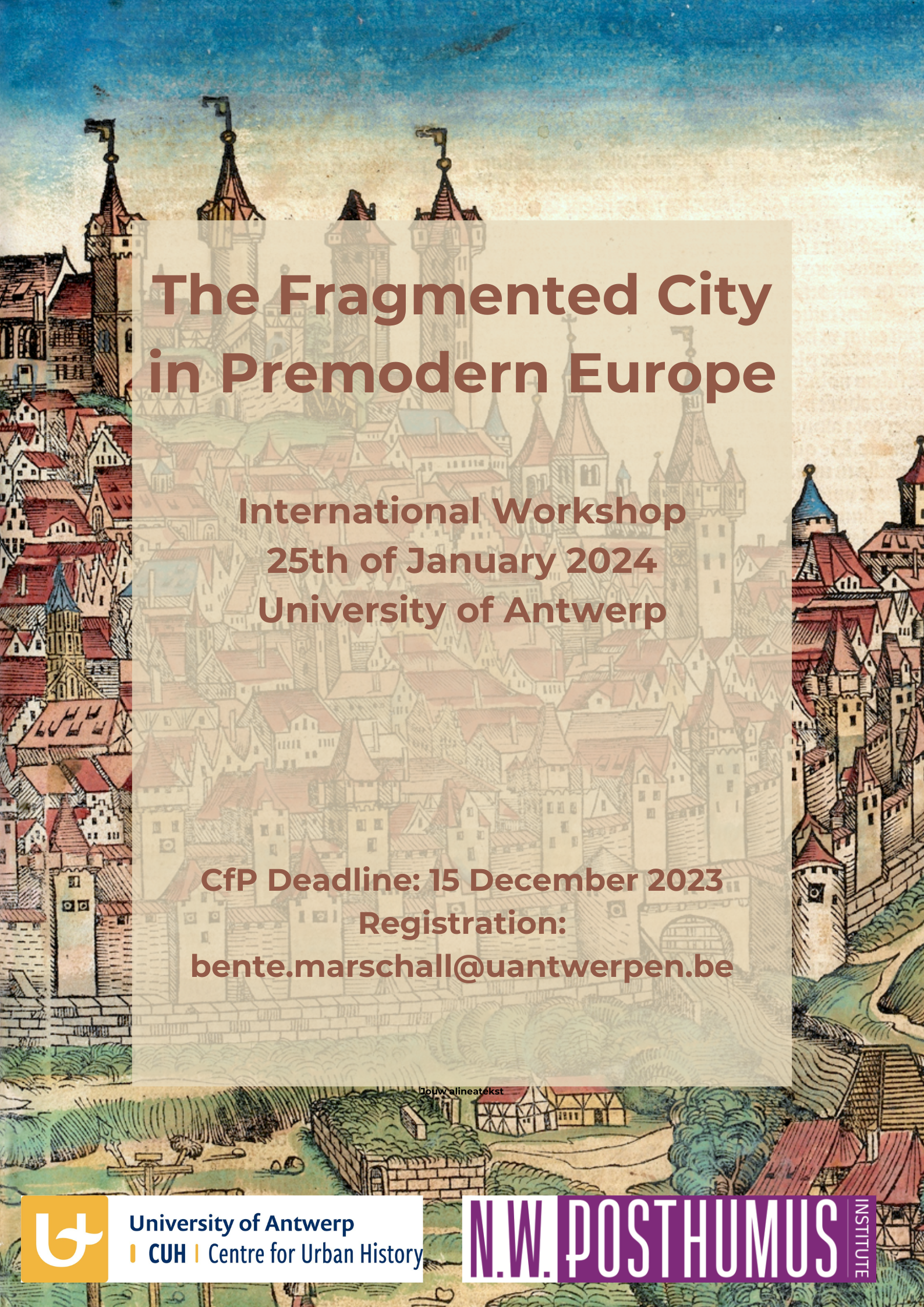
    On 25 January 2024, the Centre for Urban History of the University of Antwerp, supported by the N.W. Posthumus Institute, will host the International Workshop ‘The Fragmented City in Premodern Europe’. Organisers are Posthumus PhD Bente Marschall and Posthumus fellow Professor Peter Stabel.

    This workshop wants to explore the notion of the fragmented city. It can be defined as urban settlements with multiple and often various political, legal, cultural or social entities operating in the same space, in which the local (urban) government lacked control over the entire territory or did not encompass all social relations within the city limits. Premodern European cities were defined by a patchwork of distinct enclaves with far-reaching implications that influenced the economic, political, juridical and cultural lives of their residents. By analysing patterns of fragmentation, the workshop aims to bring together early career and advanced scholars to trace the effects of these divisions on urban cohesion and urban agency.It starts from the idea that cities did not constitute a unified whole, either as an economic unit, a political body or a cultural scene ry. It is now more widely accepted that the medieval city was polycentric, encompassing multiple power centres and distinct legal frameworks. While the subject has been predominantly explored from a political perspective, there is an increasing number of studies emphasising the social and economic consequences of extra-territoriality.

    FULL INFO