Research School for Economic and Social History

Category: Agenda

  • Jaarcongres ‘Oorlog op afstand. De Lage Landen tussen neutraliteit en betrokkenheid’ (aanmelden tot 30 november 2022)

    Jaarcongres ‘Oorlog op afstand. De Lage Landen tussen neutraliteit en betrokkenheid’ (aanmelden tot 30 november 2022)

    ~ because of scope, only in Dutch ~

    Op 9 december 2022 organiseert de werkgroep De Moderne Tijd haar jaarcongres. Het thema voor 2022 luidt ‘Oorlog op afstand. De Lage Landen tussen neutraliteit en betrokkenheid’.

    Dat de regeringen van Nederland en België in grote Europese conflicten geen partij kozen, betekende niet dat oorlogen op afstand de bevolking van beide landen onverschillig liet. Integendeel, dit congres laat zien hoe formele afzijdigheid gepaard kon gaan met een sterke publieke betrokkenheid. Op welke manieren werd door diverse groepen aan dit engagement vorm gegeven? Wat waren de beweegredenen van burgers om zich in te zetten voor humanitaire hulp? Hoe beïnvloedde ‘de oorlog van anderen’ het publiek debat en hoe werd het verbeeld in de populaire cultuur? Door op deze vragen een antwoord te geven beoogt het programma niet alleen de veelzijdigheid en veranderlijkheid van de publieke betrokkenheid bij ‘oorlogen op afstand’ in kaart te brengen, maar tevens inzicht te krijgen in de rekbaarheid van het neutraliteitsbegrip in de Lage Landen.

    Zie voor de toegangsprijs (inclusief lunch) onderstaande knop voor meer info, voor studenten en promovendi geldt een gereduceerd tarief. Aanmelden is mogelijk tot 30 november 2022 per e-mail via dr. Marjet Dolstra.
    Volledige info (pdf)

  • Phd Defence Esther Beeckaert (Ghent University)

    Phd Defence Esther Beeckaert (Ghent University)

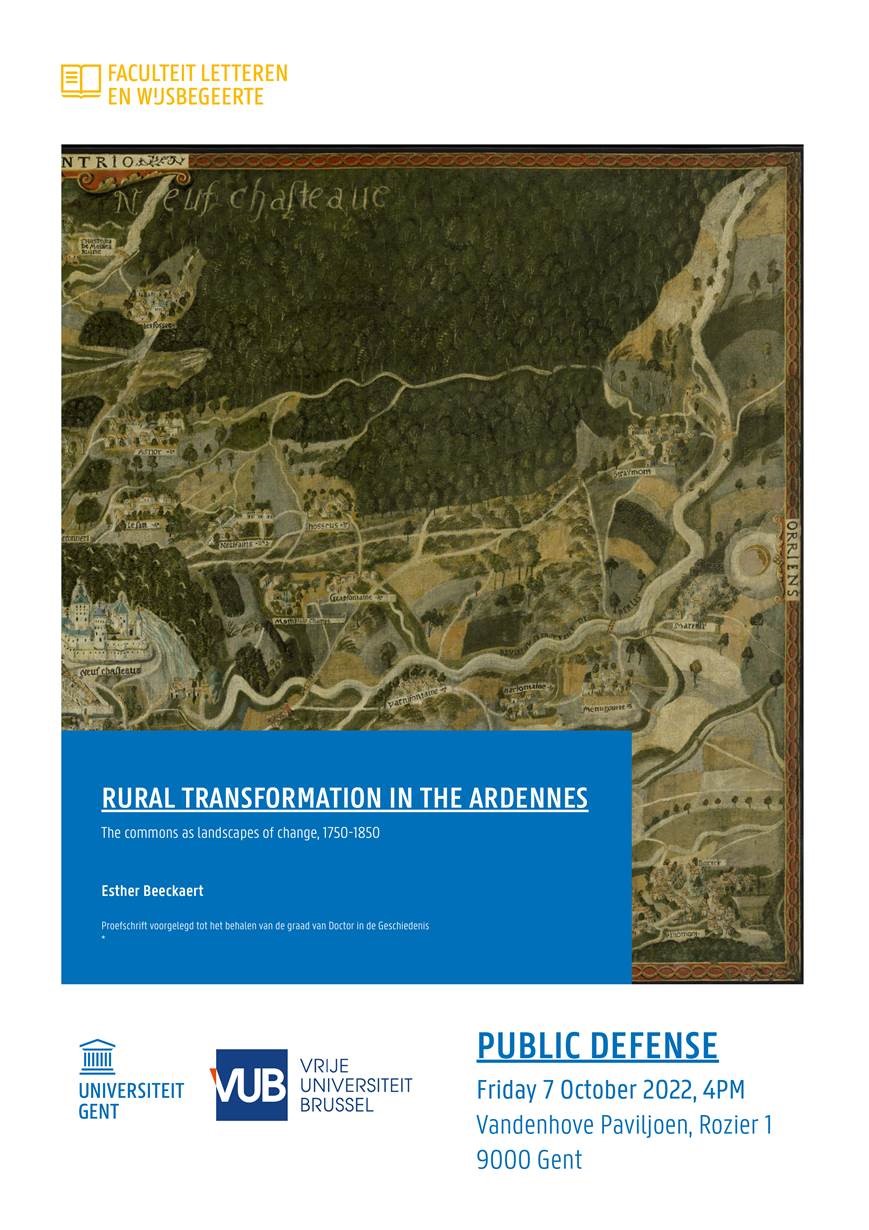
    On 7 October 2022 at 16:00 sharp, Posthumus alumna Ester Beeckaert will defend her PhD thesis ‘Rural transformation in the Ardennes: The commons as landscapes of change, 1750-1850’ to obtain her PhD in History from Ghent University. Promotors are Professor Eric Vanhaute and Professor Wouter Ryckbosch. After the session, there will be a reception at the atrium of the Magnel-wing of the Faculty’s Library at the opposite side of the street.

    More info

  • Najaarsbijeenkomst SGVDO ‘Garnizoensstad Maastricht in de achttiende eeuw’

    Najaarsbijeenkomst SGVDO ‘Garnizoensstad Maastricht in de achttiende eeuw’

    ~ because of scope, in Dutch only ~

    Op 20 oktober 2022 organiseert de Stichting Geschiedenis van de Overheidsfinanciën (SGVDO) haar najaarsbijeenkomst in Maastricht. Het thema van de najaarsbijeenkomst is ‘Garnizoensstad Maastricht in de achttiende eeuw’. De stad viel onder de soevereiniteit van de Staten-Generaal, maar betaalde geen belasting aan de Unie. De stad draaide wel op voor de huisvesting van het garnizoen en het onderhoud van een deel van de fortificaties.

    Het programma bestaat uit ontvangst met koffie en thee, een aantal lezingen, en aansluitend een wandeling langs de stadsmuren en (op eigen kosten) diner. Opgeven voor de bijeenkomst kan per e-mail.

    Meer info

  • Masterclass Professor Carl Nightingale at ESHCC (Rotterdam)

    Masterclass Professor Carl Nightingale at ESHCC (Rotterdam)

    The Erasmus Initiative ‘Vital Cities and Citizens’ invites graduate and doctoral students, post-docs, or young scholars working on urban inequality to participate in our master class with Professor Carl Nightingale, to be held at the Erasmus School of History, Culture and Communication of Erasmus University Rotterdam on 23 August 2022.

    About the speaker

    Although Nightingale was trained as an historian, his work is also interesting for researchers from other fields in the social sciences. Carl has an interdisciplinary approach and tries to show how long term developments have impact on current societies. In his seminal book Segregation: A Global History of Divided Cities (2012), Carl Nightingale argues that Western expansion depended on global production of inequality and segregated urban spaces. Inequality and segregation are, therefore, serious challenges since the origin of urban  settlements in world history. Nightingale shows that segregation should always be studied in their local and global context. Racial segregation can be traced to a certain point in global history as a product of transnational intellectual networks. The scale and intensity of segregation did not result in similar patterns globally. Local conditions mattered and each case needs to be assessed in its own context.

    About the Masterclass

    This masterclass invites PhDs and young scholars to reflect on how patterns of exclusion of all kinds – social, racial, religious, or economic – and of urban segregation do appear in their own work.

    How to apply

    The deadline for presenting participants has passed. There is however limited room for non-presenting participants. Those who want to use this opportunity, should send an e-mail expressing their interest to Burak Fici.

    Full info

  • Inaugural lecture Professor Elise van Nederveen Meerkerk

    Inaugural lecture Professor Elise van Nederveen Meerkerk

    On 8 September 2022, Professor Elise van Nederveen Meerkerk will deliver her inaugural lecture ‘Where did all the workers go? Women, industrialization, and the decline of hand spinning in Europe and Asia’ at Utrecht University. Professor Elise van Nederveen Meerkerk is Professor of Economic and Social History at Utrecht University since 1 February 2020 and works in the field of Gender and work in comparative historical perspective.

    Attending the inaugural lecture at Utrecht University Hall (Academiegebouw) is on invitation only; the lecture will also be streamed, URL link to the live-stream will be available in due time.

    More info

  • Applied History Conferentie 2022

    Applied History Conferentie 2022

    ~ because of scope, in Dutch only ~

    Dankzij de Toegepaste Geschiedenis kunnen we hedendaagse gebeurtenissen en ontwikkelingen beter begrijpen. Om dit vakgebied een podium te geven, organiseert het Departement Geschiedenis en Kunstgeschiedenis van de Universiteit Utrecht op 24 september 2022 een conferentie over Applied History.

    Tijdens de dag kan men deelnemen aan verschillende panels, voorgezeten door prof. dr. Annelien de Dijnprof. dr. Beatrice de Graafdr. Saskia Stevensdr. Sanne Frequinprof. dr. Joost Dankersprof. dr. Leen Dorsman en dr. René Koekkoek.

    Deelname is kosteloos, maar vanwege het beperkte aantal plaatsen is reservering vooraf noodzakelijk.

    Volledige info en reserveren
     
    Programma (pdf)

  • Masterclass ‘Between Integration and Expulsion’ with Beate Althammer

    Masterclass ‘Between Integration and Expulsion’ with Beate Althammer

    The Ghent University Research Group “Social History since 1750” in collaboration with the N.W. Posthumus Institute is hosting the masterclass ‘Between Integration and Expulsion: Actors, Practices and Subjects of Migration Control in 19th- and 20th-century Europe’, delivered by Dr Beate Althammer (Institut für Asien- und Afrikawissenschaften, Humboldt Universität zu Berlin) on Friday 30 September 2022 at Ghent University.

    About the speaker

    Dr Beathe Althammer is a postdoctoral researcher at the Institute of African and Asian Studies at Humboldt Universität zu Berlin and specialises in the history of migration, migration control, crime, poverty and social policies. She is currently leading the research project The Borders of the Welfare State: Migration, Social Rights and Expulsion (1850-1933). She is author of Das Bismarckreich 1871-1890 (2009), co-editor on the volumes Bettler und Vaganten in der Neuzeit (1500-1933) (2013), The Welfare State and the ‘Deviant Poor’ in Europe, 1870-1933 (2014) and Rescuing the Vulnerable. Poverty, Welfare and Social Ties in Modern Europe (2016).

    Aims of the masterclass

    The masterclass ‘Between Integration and Expulsion: Actors, Practices and Subjects of Migration Control in 19th- and 20th-century Europe’ offers PhD candidates and early-stage post-docs the opportunity to discuss their research with an expert in the field. During the masterclass a maximum of 6 participants can present their work on the basis of a pre-submitted paper (with a maximum of 6,000 words) and discuss difficulties and opportunities of their research. To engage in a productive discussion, all participants are invited to read each other’s papers in advance.

    How to participate

    Researchers working on migration, migration control and mobility in nineteenth and twentieth century Europe are invites to apply by sending an abstract (c. 300 words) before 15 August 2022 (extended deadline) to organiser Maïté Van Vyve MA, Posthumus PhD candidate at Ghent University.

    Selected candidates will be notified by Friday 19 August 2022. A full working paper should be submitted no later than Monday 1 September. The paper can be a chapter section of the PhD, an article in preparation, or the presentation of the whole project. Participants are expected to briefly present their work (maximum of 5 minutes) and mainly focus on formulating some concrete questions for input and feedback.

    Mail organiser

  • Masterclass Professor Eithne Luibhéid

    Masterclass Professor Eithne Luibhéid

    On 14 July 2022, Professor Eithne Luibhéid will give a masterclass at Leiden University. This masterclass is organised by Posthumus PhD candidate Jamel Buhari MA and Professor Marlou Schrover and forms a unique opportunity for PhD students working to interact on a personal level with this important author. Professor Eithne Luibhéid is Professor of Gender and Women’s Studies at the University of Arizona and a key author on the connections among queer lives, racialization processes, state immigration controls, and citizenship.

    At this masterclass, you will able to present your research in progress and receive feedback on this from both Professor Luibhéid and fellow participants. Participating in a masterclass is also one of the requirements for the Posthumus Advanced Training Programme. If you want to join, please send an e-mail to the organisers via the button below.

    E-mail organisers

  • Workshop ‘Digital mapping for historians with QGIS’

    Workshop ‘Digital mapping for historians with QGIS’

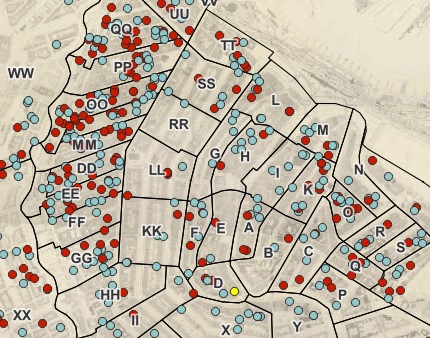
    A map can be an excellent way to visualize your research, but only a small percentage of people know how to make them. Have you been wanting to learn more about digital mapping for your research, but do not know where to start? Or struggle to make time to teach yourself? This workshop may be for you!

    In this workshop, which is made possible by the N.W. Posthumus Institute, the HiDo Scientific Network for Historical Demography, and the Quetelet Center, attendees will be taught the essentials of digital mapping using the world’s most popular open source application QGIS. By the end of this two half-day hands-on workshop, you will be able to combine different types of data to create your own historical maps for use in papers, presentations and other sessions.

    Attendance is free of charge. We can host a maximum of 15 participants for this hands-on workshop, so signing up is necessary. Preference will be given to Posthumus-students and fellows, a wait list will be used in case interest exceeds the number of spaces available. Applicants should provide a brief motivation (a few sentences in English or Dutch) on how the workshop might be useful or interesting for your research.

    Applicants should provide a brief motivation (a few sentences in English or Dutch) on how the workshop might be useful or interesting for your research ultimately 15 July 2022 via e-mail to the organisers (see button below). Please make sure to include information on 1) your institutional affiliation, 2) your position (which year of the PhD or (for ECR) role within university), and 3) brief motivation of the reasons why you are interested in attending.

    E-mail organisers

    Full info (pdf)

  • Workshop ‘Globalisation and Long-Run Development in Asia and Africa (ca. 1800-2000)’

    Workshop ‘Globalisation and Long-Run Development in Asia and Africa (ca. 1800-2000)’

    On 23 and 24 June 2022, members of the N.W. Posthumus Institute Research Network ‘Globalisation, Inequality and Sustainable Development in Long-Term Perspective’ will organise a workshop on the theme ‘Globalisation and Long-Run Development in Asia and Africa (ca. 1800-2000)’. Keynote speaker at this event will be Professor Deepak Nayyar, Emeritus Professor of Economics at Jawaharlal Nehru University, New Delhi, India.

    Content

    How has globalization, that is the rise of global trading volumes and the integration of global markets, affected the economic fortunes of countries in the Global South since the early nineteenth century? To what extent have societies in Africa and Asia been pushed towards primary commodity production as a result the newly emerging global division of labour and to what extent has this hindered their economic growth in the nineteenth and twentieth centuries? How have different geographic and ecological conditions, as well as local and colonial institutions, affected this relationship? It is the purpose of this workshop to bring together some 20 economists and economic historians working on the role of trade in the long-term development of Africa and Asia for a two-day workshop to be held in Wageningen to be held 23 and 24 June 2021.

    Program

    Thursday 23 June 2022
    09:30-09:45 Walk-in with coffee
    09:45-10:00 Welcome and introduction by Dr Pim de Zwart (Wageningen UR)
    10:00-12:00 Session I
    Dr David Chilosi (King’s College London) (w/ Professor Giovanni Federico (New York University Abu Dhabi)
    The welfare gains of the first globalization: a within-country perspective
    Professor Giovanni Federico (New York University Abu Dhabi) (w/ Dr Christopher Absell (Università di Pisa) & Professor Antonio Tena-Junguito (University Carlos III de Madrid)
    Breaking the ties that bind: colonial trade ties and export growth in the poor periphery, 1950-90
    Professor Ewout Frankema (Wageningen UR)
    From the Great Divergence to South-South Divergence
    13:00-15:00 Session II
    Professor Markus Lampe (WU Vienna) (w/ Dr Vellore Arthi (University of California, Irvine), Ashwin R. Nair (National Bureau of Economic Research, India) & Professor Kevin Hjortshøj O’Rourke (New York University Abu Dhabi)
    The Impact of Interwar Protection: Evidence from India
    Professor Tirthankar Roy (London School of Economics)
    Tropical development: The environmental origins of world inequality
    Dr Janneke Pieters (Wageningen UR)
    Trade liberalization and Gender Inequality in India
    15:00-15:15 Coffee and tea
    15:00-16:45 Session III
    Dr Kate Frederick & Professor Elise van Nederveen Meerkerk (both Utrecht University)
    Local advantage in a global context. Competition, adaptation and resilience in textile manufacturing in the ‘periphery’, 1860-1960
    Dr Michiel de Haas (Wageningen UR) (w/ Dr Bram van Besouw (Erasmus University Rotterdam))
    The Great Depression and Social Distress in British Colonial Africa: Evidence from Prison Records
    17:00-18:30 Keynote lecture Professor Deepak Nayyar (Jawaharlal Nehru University)
    Globalization, History and Development: A Tale of Two Centuries
    18:30-19:00 Drinks
    19:00-….. Dinner
    Friday 24 June 2022
    09:00-11:00 Session IV
    Professor Pierre van der Eng (Australian National University, Canberra)
    Active land markets despite ‘fuzzy’ property rights in Indonesia, 1920s-1930s
    Dr Pim de Zwart (Wageningen UR) (w/ Phylicia Soekhradj BA (Wageningen UR)
    Colonial Paradox: Sugar, Property Rights and Land Inequality in Java
    Dr Jessica Vechbanyongratana (Chulalongkorn University, Bangkok)
    Western Land Institutions and Provincial Land Markets in Central Siam, 1885-1908
    11:00-11:15 Coffee and tea
    11:15-12:45 Session V
    Professor Anne Booth (SOAS University of London)
    Trade and Exchange Rate Policies before and after Independence in Asia
    Dr Montserrat Lopez Jerez (St. Andrews University)
    The economic phoenix of Asia: growth and shrinking in Vietnam
    12:45-13:30 Lunch
    13:30-15:00 Session VI
    Dr Robrecht Declercq (Ghent University)
    Economic Decolonization in the Congo 1960-1980
    Tanik Joshipura MSc (Wageningen UR)
    Feeding Urban Africa: the role of city location and population growth
    15:00-15:15 Coffee and tea
    15:15-16:45 Session VII
    Professor Ulbe Bosma (International Institute of Social History)
    Sugar, Peripheralisation and Industrialisation in colonial India, Indonesia and the Philippines
    Robert Keenan MA (Wageningen UR)
    Effects of Migration in Colonial Southeast Asia
    16:45-17:30 Closing discussion
    17:30-….. Drinks and dinner

    How to participate

    You are cordially invited to join the Workshop on “Globalization and Development in Asia and Africa, 1800-2020” Please let the organizer know you are interested in partaking in the workshop (free of charge – lunch will be provided) by sending an e-mail to the organiser, Dr Pim de Zwart (Wageningen UR)

    e-mail organiser
     
    program as pdf