Research School for Economic and Social History

Category: Agenda

  • Public Event on Trend Reversals in the Public Health of Limburg, Past and Present – deadline registration 27 April 2022

    Public Event on Trend Reversals in the Public Health of Limburg, Past and Present – deadline registration 27 April 2022

    On 29 April 2022, the Centre for the Social History of Limburg and Maastricht University organise a public event on trend reversals in the public health of Limburg, in the past and present. Posthumus PhD candidate Mayra Murkens is co-organiser of the event and will present her findings on the historical trend reversal in the high infant and adult mortality in early twentieth-century Maastricht, which is part of her dissertation on socioeconomic and gender inequalities in the course of the health transition in Maastricht.

    Theme

    The province of Limburg is known for its historical and present-day lower life expectancy compared to other Dutch regions. Speakers from various backgrounds will elaborate on how trend reversals in this disadvantageous position in public health have been or should be accomplished. What were the causes of the lagging position of Limburg? And how has this position been reversed? Which parallels and differences can be found between the historical lag in public health and the present-day one?

    How to participate

    The event is open to everyone interested, although the working language will be Dutch. Please register before 27 April 2022 by sending an email to the organisers.

    FULL INFO AND PROGRAMME
     
    FLYER (PDF)

  • Studiedag Werkgroep Stadsgeschiedenis – ‘Panorama’s’

    Studiedag Werkgroep Stadsgeschiedenis – ‘Panorama’s’

    ~ because of scope, only in Dutch ~

    Op donderdag 14 april 2022 organiseert de werkgroep Stedengeschiedenis een bijeenkomst bij de Rijksdienst voor het Cultureel Erfgoed (Smallepad 5, Amersfoort) onder de titel ‘Panorama’s’.

    Programma

    Dagvoorzitter: Dr. Roos van Oosten

    13:00-13:30 Albert Boersma Ander licht op Withoos
    13:30-14:00 Discussie
    14:00-14:30 Drs. Sylvia Alting van Geusau en drs. Ester Wouthuysen – Kunstzinnig vermaak in Amsterdam. Het Panoramagebouw in de Plantage, 1880-1935
    14:30-15:00 Discussie
    15:00-15:30 Koffie en thee
    15:30-16:00 Dr. Everhard Korthals AltesNederland op zijn mooist – De achttiende-eeuwse Republiek in kaart en beeld

    16:00-16:30 Aanbieding eerste exemplaar Nederland op zijn mooist

    Aanmelding

    De studiedag is gratis voor eenieder toegankelijk, mits vooraf aangemeld; verzocht wordt daarbij aan te geven of u de bijeenkomst live of online wilt bijwonen.

    Meer info (pdf)
    Aanmelding (mail)

  • Voorjaarsbijeenkomst SGVDO: ‘Overheidsfinanciën in Nederlands-Indië’

    Voorjaarsbijeenkomst SGVDO: ‘Overheidsfinanciën in Nederlands-Indië’

    ~ because of scope, only in Dutch ~

    De voorjaarsbijeenkomst 2022 van de Stichting Geschiedenis van de Overheidsfinanciën staat in het teken van Nederlands-Indië. Kolonialisme wordt gekenmerkt door ongelijkheid: de ongelijkheid tussen moederland en kolonie (Nederlands-Indië als wingewest) en de (etnische) ongelijkheid binnen de koloniale samenleving. Beide aspecten komen aan bod. Afhankelijk van coronasituatie vindt de bijeenkomst in Leiden of Rotterdam plaats, zie voor updates de webpage van het event via onderstaande knop.

    De Stichting Geschiedenis van de Overheidsfinanciën (SGvdO) heeft tot doel het bevorderen van de bestudering van de geschiedenis van de overheidsfinanciën, bij voorkeur in interdisciplinair verband.

    Opgeven voor de bijeenkomst kan per e-mail via de organisatie.

    Event webpage

  • Masterclass ‘Crime and Justice in Historical Context: Theory, Methods and Perspectives’ by Prof. Robert Shoemaker

    Masterclass ‘Crime and Justice in Historical Context: Theory, Methods and Perspectives’ by Prof. Robert Shoemaker

    The research group of the project Tolerant Migrant Cities? The Case of Holland 1600-1900 in collaboration with the N.W. Posthumus Institute, in particular the Research Network ‘Inclusion, Exclusion, and Mobility’ are pleased to announce that they will be hosting a masterclass by Professor Robert Shoemaker (The University of Sheffield), on 8 June 2022 11:00 to 17:00 (lunch included) at the International Institute of Social History (IISG) in Amsterdam.

    On the next day, 9 June, the related Symposium ‘Voices in the Justice System: Agency of Victims, Plaintiffs, Witnesses and the Accused in Global Perspective’ will also be held at the IISH, follow this link for additional info.

    About the Speaker

    Professor Robert Shoemaker is a Professor of Eighteenth-Century British History at the University of Sheffield who has published widely on social and cultural history, particularly urban history, gender history and the history of crime, justice and punishment. Together with Professor Tim Hitchcock (University of Sussex) and the late Professor Clive Emsley (1944-2020), he initiated the Old Bailey Proceedings Online. Currently he is part of an interdisciplinary project funded by the ESRC on long-term patterns of victims’ access to justice in England over the course of three centuries.

    Focus of the Masterclass

    The focus of this masterclass will be a methodological discussion on the use of judicial sources as a lens onto everyday lives. We therefore invite junior researchers working on a variety of topics through the lens of judicial sources to apply. Topics could include, but are not limited to: gender, migration, empire, class, agency, crime and policing. A key aspect of this masterclass will be to understand the differences between English Common Law and other legal systems, since it is the legal framework that shaped the nature of the judicial sources produced in each system.

    PhD and Postdoc Participation

    The masterclass offers PhD candidates and early-stage post-docs the opportunity to discuss their research with an expert in the field by presenting a paper. The paper can be a chapter section of the PhD, an article in preparation, or the presentation of the whole project, but the focus should be on the methodological aspect of the research and contain at least the following information:

    1. How have your principal sources been shaped by the legal and judicial system in which they were created?
    2. How can you use those sources, despite their limitations, to gain an understanding of the circumstances, point of view and agency of those who were accused of crime?
    3. Explain the theoretical perspectives you are using in your research. Bearing in mind the limitations of your sources, how will you use them to address those theoretical questions?

    Participants are expected to briefly present their work (maximum of 5 minutes) and mainly focus on formulating some concrete questions for input and feedback.

    How to participate

    Please note that the deadline for papers to be presented has passed. There are however a few spots available for non-presenting participants. If you want to attend as non-presenting participant, please contact the organisers. Please also indicate whether you would like to attend just the masterclass, or both the masterclass and the symposium to be held the next day (see below) .

    Participants are also welcome to attend the related symposium ‘Voices in the Justice System: Agency of Victims, Plaintiffs, Witnesses and the Accused in Global Perspective’, which will be held at the IISH the very next day, 9 June 2022.

    Contact organisers / Apply

  • European Social Science History Conference 2023

    European Social Science History Conference 2023

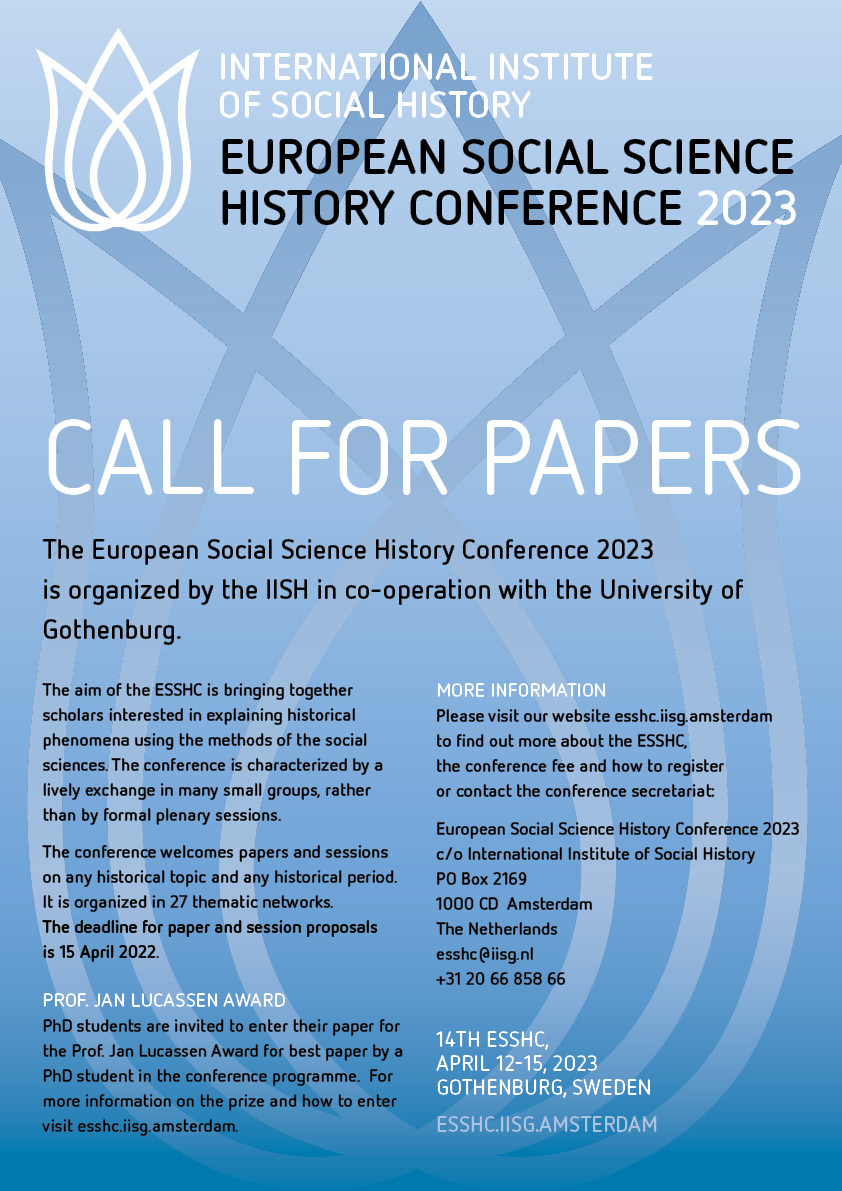
    The 14th European Social Science History Conference is organized by the IISH in co-operation with the University of Gothenburg, in Gothenburg, Sweden and will take place on 12-15 April 2023. Please note this is a postponed date for the conference originally intended for 2022.

    The aim of the ESSHC is bringing together scholars interested in explaining historical phenomena using the methods of the social sciences. The conference is characterized by a lively exchange in many small groups, rather than by formal plenary sessions. The conference welcomes papers and sessions on any historical topic and any historical period. It is organized in 27 thematic networks.

    Conference website

  • 18th History of European Integration Research Society Conference

    18th History of European Integration Research Society Conference

    The History of European Research Society (HEIRS) will hold its 18th annual conference under the title “A means to what end: the interrelation between visions of Europe and economic policies.” The conference will take place on 31 May and 1 June 2022 at the University of Glasgow. The conference allows PhD candidates and early career researchers to present and discuss their work.

    The aim of the 18th annual HEIRS conference is to analyse the interrelation between different motivations and visions of Europe and the European Community /European Union’s economic policies during the second half of the 20th century. This conference proposes to bundle and further develop various approaches by looking for histories that study European economic policies and their theoretical/ideological underpinnings, as well as the ways in which these economic policies themselves influenced visions and ideas for Europe.

    Full info

  • Workshop ‘A Tapestry of Rules’

    Workshop ‘A Tapestry of Rules’

    ~ Please note this event has been rescheduled from its original dates in April 2022 to 30 June-1 July 2022 ~

    On 30 June and 1 July 2022, Dr Kate Frederick, affiliated with the Research Group Economic and Social History at Utrecht University will organise the Workshop ‘Tapestry of Rules: This Institutions and Cloth Industries in Global Comparative Perspective, 1750-2000’. This workshop specifically explores the role of formal and informal institutions – the social, economic, political, and cultural “rules of the game” – in influencing textile manufacturing in different world regions over time, with particular reference to the interlinking relationships between institutions and other explanatory variables.

    Traditions of textile manufacturing have developed in nearly all parts of the globe. However, the characteristics and development trajectories of these industries have differed markedly over time and across space. The global centre of manufacturing gravity has shifted from East to West and back again over the past three centuries, while in some cases, handicraft industries have persisted, but industrialization has long remained elusive. Scholars like Williamson, Pomeranz, and Mokyr have pointed to a number of key explanatory factors that have influenced temporally and geographically divergent industrial developments, including market forces, resource endowments, and institutions.

    This workshop encourages temporal and geographic comparisons and welcomes contributions from scholars studying all parts of the globe. This workshop forms part of the ERC project Race to the bottom? Family labour, household livelihood and consumption in the relocation of global cotton manufacturing, ca. 1750-1990.

    Full info

  • WORCK Training School – Rewriting Labour Histories: Perspectives from the Globe

    WORCK Training School – Rewriting Labour Histories: Perspectives from the Globe

    The WORCK Training School will bring together 20-25 MA and PhD students from all over Europe during a 5-day program. The program includes lectures from international scholars, roundtables, and seminars. They will focus on theoretical and methodological issues as well as on the implementation of digital methods in research. An important part of the programme is reserved for a Student Conference with comments from senior researchers.


    Full info

  • Historicidagen 2022 – ‘Grenzeloze Geschiedenis’ / Historians’ Days 2022 – ‘History Beyond Borders’

    Historicidagen 2022 – ‘Grenzeloze Geschiedenis’ / Historians’ Days 2022 – ‘History Beyond Borders’

    From 25 until and including 27 August 2022, the annual Historicidagen will be held in Rotterdam. The Historians’ Days are jointly organized by the Royal Netherlands Historical Society (KNHG) and the History Department of the Erasmus University Rotterdam (EUR), are meant for everyone interested in history, professionally or otherwise.

    The event showcases the many diverse and dynamic ways of doing history. Through a wide spectrum of lectures, debates and workshops, the Historians’ Days tackles issues and challenges on the frontline of historical research and public debates.

    The Historians’ Days 2022 evolve around the theme of History Beyond Borders, and actively promote diversity within participants, audience, program, stories, methods and presentations.

    CONFERENCE WEBSITE

  • Expert Meeting Sport, Migration, Citizenship, ‘Race’ and National Identity: Towards a new research agenda

    Expert Meeting Sport, Migration, Citizenship, ‘Race’ and National Identity: Towards a new research agenda

    ~ Please note that this event has been postponed from its original dates in February to 23-24 June 2022 ~

    On 23 and 24 June 2022, the Erasmus School of History, Culture and Communication (Erasmus University Rotterdam) organises an Expert Meeting ‘Sport, Migration, Citizenship, ‘Race’ and National Identity: Towards a new research agenda’. This meeting is supported by the Research Network ‘Routes and Roots in Colonial and Global History’ of the N.W. Posthumus Institute, the Sport and Nation network and the Football and Race network.

    Sport and Nation

    In the international sports arena, the legal guidelines and the moral justifications for citizenship and national belonging are stretched. By taking high profile examples from international sports events, the Sport and Nations network seeks to unveil the complexities behind the question: who may represent the nation? While the presence of foreign-born athletes in national football teams and the Olympics has a long history, it is often believed that the World Cup and the IOC have become more migratory over time. The presumed increases in the volume and diversity of foreign-born athletes and footballers have, however, remained empirically untested. In this research, it is empirically tested whether the presence of athletes at the World Cup and IOC has increased over time.

    The aim of this meeting is threefold:

    1. To present the major research-results of the Sport and Nation network of the last five years.
    2. To present some of the major results from football and race scholars and the Football and race network
    3. To look for opportunities to move on in this research arena

    Football and race

    During the EURO 2020 some national teams have been kneeling to protest against racism in football and to show support to the Black Lives Matter movement, reminding us of the urgency to address issues of racism in sport. Given the racial, ethnic and national diversity of football players in men’s and, to a lesser extent, women’s football, together with its large audiences, it is important to provide more insights into how football contributes to meaning making processes related to race and ethnicity. Existing research has shown, for instance, that football commentators sometimes use racial/ethnic stereotypes when describing or talking about football players. In so doing, they reproduce larger societal discourses about race/ethnicity that sustain racial inequality. The ‘football and race network’ at Erasmus University is exploring the (re)production of discourses surrounding race and ethnicity within football, with a specific focus on the role of media and leadership and coaching, within a European perspective in particular. They do so from a critical perspective. Findings need to be placed in a wider academic and societal debate on race, popular culture and multi-ethnic society.

    Programme

    The full programme can be found online via this link.

    How to register

    The organisers invite respected and outstanding scholars to discuss the state of the art of sport and social sciences/humanities studies and look at the future. Registration is possible via the conference website.

    Conference website