Research School for Economic and Social History

Category: Agenda

  • 20th Annual MEMSA Conference (Durham University, UK)

    20th Annual MEMSA Conference (Durham University, UK)

    On 13 and 14 July 2026, the Medieval and Earl Modern Student Association (MEMSA) will organise its 20th Annual Conference at St. John’s College at Durham University. This year’s conference theme is ‘Connection, conversation and contention: encounters in the Medieval and Early Modern World’.

    All kinds of connections took shape in the period of 500 AD – 1800 AD through different means. The founding and spreading of the major monotheistic religions like Christianity, Islam and Buddhism, for example; the establishment of the silk roads, the sub-Sahara trade and other major trading sea-lanes in South East Asia; or the colonisation of the America’s and the founding of trade posts in Africa and Asia by Europeans. It was also a period of conversation, the founding of European medieval universities, the house of wisdom in Baghdad, and the emergence of a republic of letters in the Early Modern period. However, with connection also comes contention; the Arabic conquests, the crusades, the colonial conquests or the many devastating wars of the sixteenth and seventeenth century.

    To investigate these interactions, the MEMSA conference committee invites postgraduates to send paper abstracts of 300 words. The papers must focus on either connection, conversation or contention in a broader sense during the Medieval or Early Modern period. Abstracts should be submitted ultimately by 9 March 2026 via the dedicated form (see full info via button below).

    FULL INFO

  • Workshop ‘Histories of taxation, (in)equality, and redistribution’ – deadline proposals 6 February 2026

    Workshop ‘Histories of taxation, (in)equality, and redistribution’ – deadline proposals 6 February 2026

    The Research School Political History and the Duitsland Instituut Amsterdam jointly organise the workshop ‘Histories of taxation, (in)equality, and redistribution’ on Friday 13 February 2026.

    The workshop will include contributions by Professor Marc Buggeln (Europa Universität Flensburg), Emeritus Professor Marjolein ’t Hart (VU Amsterdam), and Dr Maarten Manse (Linnaeus University), and explores the role of taxation in relation to (in)equality, redistribution, and colonial power relations.

    The workshop is free of charge and explicitly open to research master students and PhD candidates and is credited with 1 EC. Those who want to participate should send an email, including a short statement (max. 1 page) reflecting on how the history of taxation could provide new perspectives on your research, to The Research School Political History ultimately by 6 February 2026.

    FULL INFO (PDF)

  • Dag van de Nieuwste Geschiedenis – Journée de l’Histoire Contemporaine 2026

    Dag van de Nieuwste Geschiedenis – Journée de l’Histoire Contemporaine 2026

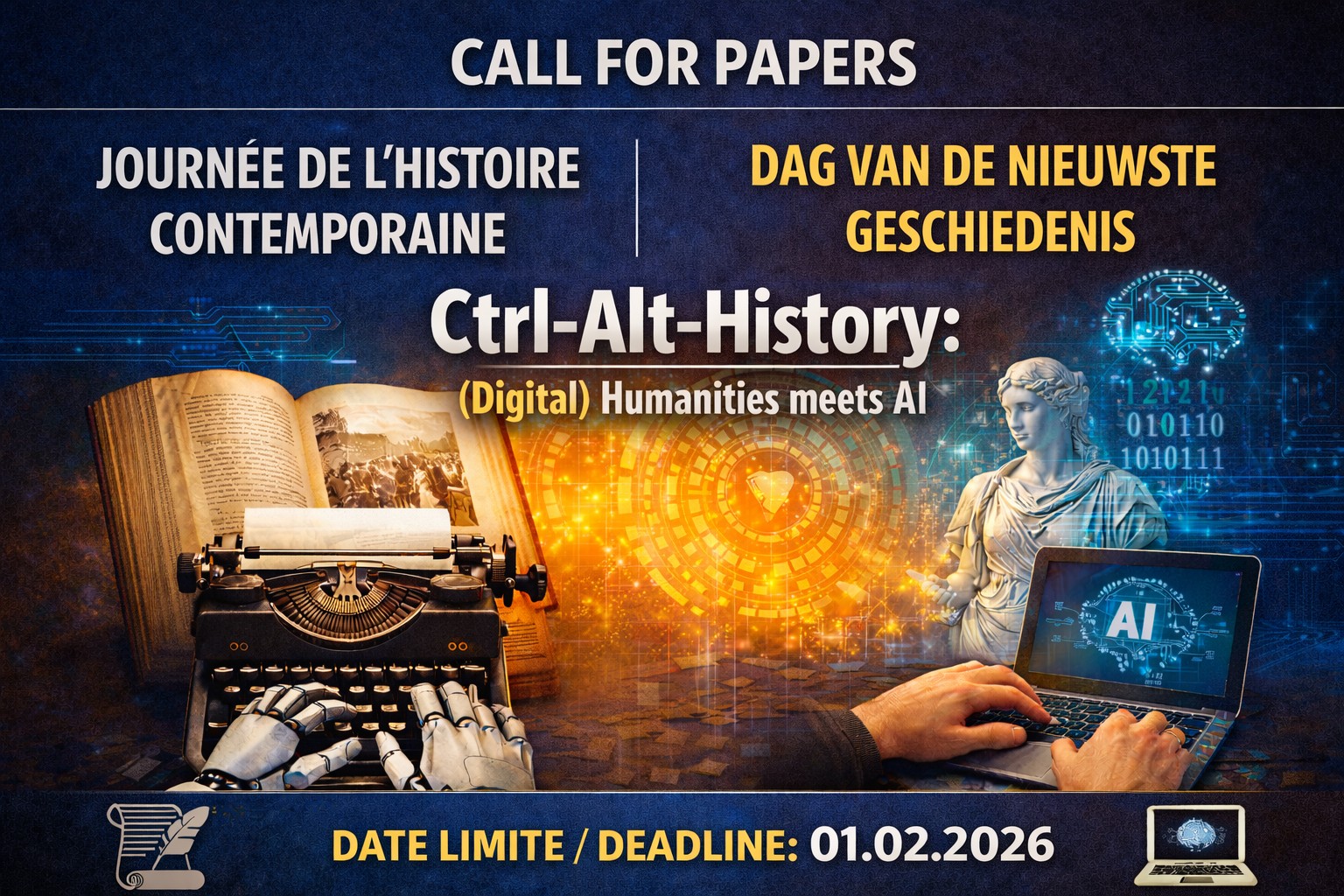
    The Belgische Vereniging voor Nieuwste Geschiedenis – Association belge d’Histoire contemporaine BVNG-ABHC and the University of Antwerp call for papers for the 2026 edition of the Dag van de Nieuwste Geschiedenis – Journée de l’Histoire Contemporaine, to be held on 29 April 2026 at the City Campus (Hof van Liere) of the University of Antwerp.

    The theme of the 2026 edition is ‘Ctrl-Alt-History: (Digital) Humanities meets AI’. The conference aims to focus on the use of AI in (Belgian) historical research, heritage management, and education, and to provide a forum for exploring the opportunities, risks, and challenges of AI within the Belgian historical landscape by inviting contributions that approach these developments critically, empirically, and/or pedagogically.

    Proposals of 300–500 words, clearly stating the research objective, methodology, expected contribution, and central questions, should be submitted ultimately by 1 February 2026. Proposals in Dutch, French, or English are accepted. Early-career researchers and graduate students are particularly encouraged to submit. Further details are to be found in the full call (via button below).

    FULL INFO

  • National Meeting ‘Towards New Horizons of Scholarly Publishing’

    National Meeting ‘Towards New Horizons of Scholarly Publishing’

    On 5 and 6 February 2026, Radboud University will host the National Meeting ‘Towards New Horizons of Scholarly Publishing’. Goal of this event is to bring researchers together who care about the future of the academic publishing system and are motivated to make a positive change.

    Participants will explore what Diamond Open Access (DOA, a fully open publishing model where no fees are asked for publishing or reading) has to offer. Keynote speakers will address a breadth of topics concerning DOA, such as the national and European infrastructure of DOA, challenges in transitioning to such a system, starting and managing a DOA journal or flipping a journal, and many more.

    Attendance is free of charge, but as the number of places is limited, prior registration is requested.

    FULL INFO

  • Workshop ‘Writing New Urban History’ (Brussels, 16 January 2026)

    Workshop ‘Writing New Urban History’ (Brussels, 16 January 2026)

    The Centre for Urban History and the Centre of Excellence of the Antwerp Interdisciplinary Platform for Research into Inequality (AIPRIL) at Antwerp University jointly organise a workshop at the premises of the Research Foundation – Flanders (FWO) in Brussels on ‘Writing New Urban History’, related to the recent publication of the 3-volume ‘The Cambridge Urban History of Europe’.

    The organisers seize the opportunity of this recent publication to look ahead to the future of urban history. For this workshop, several promising scholars (among whom several Posthumus-fellows) have been challenged to critically reflect on the New Cambridge Urban History of Europe as a companion to their own innovative research in the field. The workshop will be introduced by the editor if the publication and long-standing Posthumus fellow Maarten Prak.

    Attendance is free of charge, but prior registration is required.

    FULL INFO (PDF)

  • STONEM Workshop: Connected by/with/to the Dutch (1900-2025) – prior registration requested

    STONEM Workshop: Connected by/with/to the Dutch (1900-2025) – prior registration requested

    On 23 January 2026, the Research Team of the project ‘Sustainability Trade-offs in the Netherlands’ Entangled Modernization (STONEM) 1900-2020’ will organise the workshop ‘Connected wit/by/to the Dutch (1900-2025)’.

    This workshop examines the concept of entangled histories in relation to the Dutch past and its global connections from 1900 to 2025. It brings together scholars from different disciplines to explore how historical relationships—whether cultural, economic, political, legal, or material—shape and reshape one another over time. Key themes include multidirectional exchange, structures of power and inequality, colonial and postcolonial entanglements, and efforts to resist or break away from unequal connections. The Dutch case, especially in colonial and postcolonial contexts, illustrates how these entanglements persist, shift, and sometimes intensify after decolonization, raising questions about continuity, rupture, resistance, and agency.

    Confirmed speakers are Elise van Nederveen Meerkerk (Utrecht University), Pim de Zwart (Wageningen University & Research), and Frank Veraart (Eindhoven University of Technology), all also board members of the N.W. Posthumus Institute.

    Participation is free, but prior registration is required because of catering and limited seating. The registration link is to be found on the workshop page (see button below).

    FULL INFO

  • Launch new ESTA data & TIDES / documentary screening Slave Island

    Launch new ESTA data & TIDES / documentary screening Slave Island

    The International Institute of Social History invites you to join the Exploring Slave Trade in Asia (ESTA) Database’s second data launch on 12 December 2025. Main organisers are Posthumus PhDs Britt van Duijvenvoorde and Pascal Konings.

    Since the launch of the ESTA Database in December 2023, the Database has significantly expanded in scope. Efforts by the ESTA team, collaborating projects at the IISH, and international partners have made possible a new data publication. With these new contributions, the ESTA Database currently contains 5,292 voyages and 9,155 subvoyages. These data lay bare previously unrecorded slave trading patterns from newly added regions such as China, Southeast India, and Mozambique with an increased chronological coverage into the twentieth century. During the event, the ESTA team will also debut its data entry system, TIDES. This entry system allows users to contribute data on slave trade voyages while retaining full data ownership, and to annotate existing ESTA voyages.

    The launch of the new data and entry system will be accompanied by several data and project presentations from researchers that are related to ESTA or the field of Indian Ocean slavery, among whom Posthumus PhDs Britt van Duijvenvoorde and Philipp Huber.

    After these presentations, there will be a screening of the documentary Slave Island, which follows the activist Jeremy Kewuan in his quest to eradicate human trafficking from Sumba, the Indonesian island he calls home. The documentary forms a testimony of the individuals who still suffer under conditions of modern slavery whilst tracing their current-day experiences back to its colonial roots. Filmmaker Jimmy Hendrickx will join the event to introduce the documentary and answer questions from the audience.

    Participation on-site is free of charge, but because of limited seating, prior registration is required via e-mail. You can also join this event online via Zoom by sending a request via e-mail.

    FULL INFO

  • Workshop ‘Channeling Middle-Class Savings, 1850-1940’

    Workshop ‘Channeling Middle-Class Savings, 1850-1940’

    On 29 and 30 June 2026 the University of Antwerp and the Paris School of Economics will host the workshop ‘Channeling Middle-Class Savings, 1850-1940’, exploring the investment of middle-class savings between the second half of the nineteenth-century and the Second World War.

    The organisers call for papers that deal with the expansion of savings banks and other financial institutions competing to attract household savings, the government’s involvement in the management and use of savings, as well as the investment decisions of individual households. Submissions of both descriptive studies and analytical papers are encouraged; scholars at all career stages and diverse backgrounds are invited to participate in this workshop.

    Submissions, either as extended abstracts (5-10 pages) or as full paper drafts, should be submitted ultimately on 5 January 2026 via e-mail.

    FULL CALL (PDF)

  • Workshop ‘Networks in History’ (Huizinga Institute & N.W. Posthumus Institute)

    Workshop ‘Networks in History’ (Huizinga Institute & N.W. Posthumus Institute)

    The Huizinga Institute and the N.W. Posthumus Institute are offering a 3-day workshop on ‘Networks in History’, to be held on 21-23 January 2026 at the International Institute of History in Amsterdam.

    Description and aim

    Historical network analysis as a mode of enquiry is gaining traction in the humanities. Embedded in the interdisciplinary field of network sciences, and digital humanities, scholars have utilised the approach in a great variety of subfields and subjects within the historical discipline. This thematic course aims to enable early-career researchers to consider the purpose, potential and procedure of historical network analysis for their research projects. Sessions are taught by researchers from different backgrounds who use historical network analysis in their work. The classes will treat the process and steps of reasoning prior to adopting a specific programme to enter and analyse the data. The focal point is historical network analysis but other approaches to studying networks in history will also be discussed. Before moving onto the practical ‘how’, ample attention is paid to the theoretical and conceptual ‘why’.

    Preliminary programme

    Day 1

    09:30-12:30
    Session 1
    Introduction to networks in history & Conceptual reflections – Instructor: Christophe Verbrugge
    13:30-17:00
    Session 2
    Methods and concepts (part I) – Instructor: Christophe Verbrugge

    Day 2

    09:30-12:30
    Session 3
    Methods and concepts (part II) – Instructor: Nina Geerdink
    13:30-17:00
    Session 4
    Methods and concepts (part III) – Instructor: Ivo Zandhuis

    Day 3

    09:30-12:30
    Session 5
    Hands-on workshop – Instructor: Liliana Melgar
    13:30-17:00
    Session 6
    Reflection and application – Instructor: Rick Mourits

    Participation

    The workshop is open to research master students and PhD students who are considering employing a network approach in their research. The minimum number of participants is 5, the maximum 15 participants. The course will be in English.

    Assessment and EC

    Students will be assessed on their preparation in reading the course materials and formulating questions, their participation in and contributions to the general discussions, and class attendance. After the workshop, students should write a reflection paper (1500 words max.) on the decision to adopt or not adopt the method of historical network analysis in the students’ own research. This paper should be submitted a week after the course. The final score will be on a pass/fail basis. Passing this course successfully is valued at 2 EC.

    Application procedure

    You can apply for this course via this form. Applications will be dealt with on a first-come first-served basis; in case there are more applications than places available, students already enrolled in a programme of the Huizinga Institute or the N.W. Posthumus Institute will have priority. Within a week after the deadline, all applicants will be notified about the outcome of their application.

    Course coordination

    This course is jointly offered and supported by the Huizinga Institute and the N.W. Posthumus Institute in cooperation with the International institute of History (IISH). The course is coordinated by Dr Rick Mourits (IISH) in cooperation with Eva Seuntjens and Merel Blok (both PhD candidates at IISH).

    More info

    For more info, contact Eva Seuntjens.
  • 2nd Workshop The Economic and Financial History of Colonialism

    2nd Workshop The Economic and Financial History of Colonialism

    On 26 and 27 March 20-26, the Faculty of Business and Economics of the University of Groningen and the University of Antwerp will jointly organise the second edition of the workshop series ‘The Economic and Financial History of Colonialism’ at the University of Groningen.

    This year’s theme, ‘Diversity in Development: Colonial Legacies and Varied Paths of Growth’, invites new perspectives on how colonial economic and financial systems shaped long-term development trajectories across regions. The workshop aims to foster comparative and interdisciplinary dialogue on the mechanisms through which colonial institutions, fiscal regimes, and financial structures influenced the diversity of post-colonial growth experiences.

    The organisers encourage submissions that examine how different colonial models – whether extractive or developmental, centralized or decentralized, formal or informal – produced distinctive economic outcomes. We particularly welcome comparative contributions across empires and regions, from the relatively diversified colonial economies of East Asia or the settler dominions to the more extractive or commodity-dependent cases in Africa, the Caribbean, and Southeast Asia. Both descriptive and analytical papers, including case studies and comparative research are welcomed.

    Those interested in participating in this workshop, should submit an extended abstract (500–800 words) or a full paper ultimately 15 December 2025 by e-mail.
    DOWNLOAD FULL CALL (PDF)