The N.W. Posthumus Institute presents you its Annual Report over 2020. The report describes the activities, events, and results of both the N.W. Posthumus PhD Training Programme as well as the courses delivered within the Research Master programme of the N.W. Posthumus Institute over 2020. You can download the Annual Report 2020 via the button below or by clicking the cover image.
Blog
-

Workshop ‘Methods and data for longitudinal analysis of Institutions for Collective Action’ (The Hague, 8-10 Dec.)
The Research Group ‘Institutions for Collective Action’ at the Rotterdam School of Management at Erasmus University Rotterdam organises a specialised workshop dedicated to the study of institutions for collective action (ICAs), or institutional arrangements that are formed by groups of people in order to overcome certain common problems over an extended period of time by setting certain rules regarding access to the group (membership), use of the resources and services the group owns collectively, and management of these resources and services.
The goal of this workshop is to stimulate discussion on how existing methods in other disciplines can be used for the longitudinal study of ICAs, and how innovative methodological solutions can be developed for studying ICAs. During the workshop, (historical) databases of ICAs will be used on-site, to better grasp the challenges in this context.
-

4th Conference European Society of Historical Demography
The 4th ESHD conference leading theme is ‘Human–environmental nexus in the past: understanding links between demographic variability, ecology and disease’.
Participants are encouraged to engage with and link across three different streams of historical social science analysis:
- the diversity of historical demographic behaviour across space and time;
- the study of historical health, disease, and morbidity conditions;
- human-environmental interactions in the past.
Example research questions might be:
- How do environmental conditions affect demographic behaviour across space and time?
What was its mechanism, its major drivers, and the latter’s interaction with socioeconomic, cultural, and other factors? - How far does the demographic and environmental specificity of historical populations help us understand the different ways that they responded to external epidemiological stressors?
- Can the links between demographic variability, ecology and disease be explained in a universal model, or should we rather consider many geographically disparate relationship patterns and interactions?
-

Introducing the new Posthumus staff members
With the regular quinquennial transfer of the seat of the N.W. Posthumus Institute, now hosted by the Department of History and Art History at Utrecht University, we also would like to introduce to you the new staff members of the N.W. Posthumus Institute.
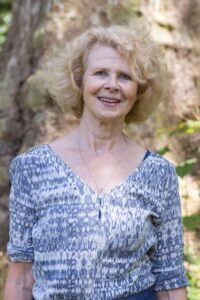
Scientific Director: Dr Jessica Dijkman

Jessica Dijkman (1960) is an associate professor in economic history. Her research focuses on the medieval and early modern era. Currently she studies the way societies in late medieval and early modern Europe coped with food crises and famines. In earlier research projects she investigated commodity market institutions in medieval Holland and compared the organization of labour, particularly craftsmanship, in the Middle Ages in Europe and the Islamic world.
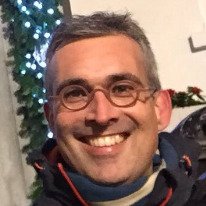
Educational Programme Director: Dr Rogier van Kooten

After initially obtaining a MSc <in Social Sciences from Tilburg University, Rogier van Kooten (1972) worked for about 20 years in IT and Consultancy. As of 2015, he returned to academia, obtaining his PhD in History from the University of Antwerp in juni 2021 on the research topic ‘Antwerp 1584. War and Inequality in Urban Space’. As of 1 September 2021, Rogier is affiliated with Utrecht University as Educational Programme Director of the N.W. Posthumus Institute.
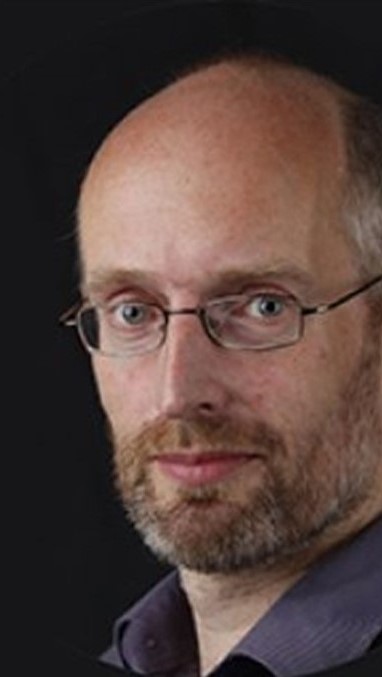
Office Manager: René van Weeren BA

Prior to his activities in the field of History, René van Weeren (1967) has worked for years as a state registered nurse within Dutch healthcare and adjacent sectors. After obtaining his BA in History from Utrecht University, he has been involved in several NWO-/ERC-research projects. From 2015 until 2019, he was also Executive Director of the International Association for the Study of the Commons. Next to being Office Manager of the N.W. Posthumus Institute, René is also involved (from September 2020 onward) Work Package 4 (Socio-economic History) in the CLARIAH PLUS project.
-

Pepijn Brandon receives VIDI Grant
Dr Pepijn Brandon, Research Director of the N.W. Posthumus Institute Research Network ‘Economy and Society of the Pre-industrial Low Countries in Comparative Perspective’ and affiliated with both the International Institute of Social History and Vrije Universiteit Amsterdam has been awarded a VIDI Grant by the Dutch Research Council (NWO) for his project ‘Land Grabbing and Dutch Empire (16th-18th century)’.
Land Grabbing is an urgent global problem with deep historical roots. This project shows how the market-oriented early modern Dutch state encouraged large-scale dispossession of land as commercial strategy within and outside Europe. The Dutch example highlights the interplay between violence and markets in the development of agrarian capitalism.
The N.W. Posthumus Institute congratulates Dr Pepijn Brandon with this grant, which will enable him to develop an own innovative line of research and to set up an own research group.
-

WEHC 2022 Paris
The 19th World Congress will be held in Paris on July 25-29, 2022. The Congress will address “resources” as one of the main challenges of the contemporary world. The Congress will consider sessions on all the categories of resources, that is natural, material, immaterial and human (work and skill): water, air, energy, food products, raw materials, labour, capital, patents, etc.
The organizing committee welcomes a large set of approaches in economic history including social history, urban and rural history, history or economics of finance, sciences and technologies, gender history, cultural history, etc. – and crossovers with other disciplinary fields, including management studies, demography, geography, environment, anthropology, sociology, socio-psychology etc. It also invites panels about methods in economic history, history of economic thought or economic theory, as well as innovative discussion of new sets of data and archives, or public communication of new (or renewed) results in economic history.
-

Posthumus Institute moves to Utrecht: new home and new faces
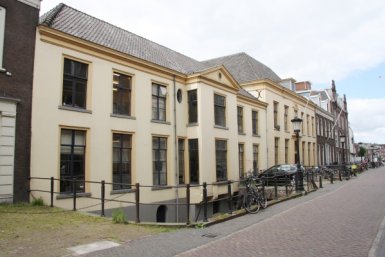
As of 1 July 2021, the N.W. Posthumus Institute is hosted at Utrecht University, Department of History & Art History. This quinquennial change of the Institute’s home seat also means a change of staff: we are therefore happy to introduce to you Jessica Dijkman as new Scientific Director, Rogier van Kooten as new Educational Director (per 1 September), and René van Weeren as the new Office Manager of the NWP. The new staff is based at the Department of History and Art History of Utrecht University and can be reached via posthumus@uu.nl. For full contact details, please check our contact page. The new staff members also want to take this opportunity to thank their predecessors, Angelique Janssens, Tim Riswick, and Milou van den Berg for their great work and efforts for the NWP over the past years. In one of the forthcoming newsletters, you will get a more extensive introduction of the new staff members.
-

Fall Seminar series Economic & Social History Utrecht University
The Economic and Social History research group of Utrecht University annually organises two series of seminars: one in spring and one in fall. Papers on a range of different topics related to economic and social history, from Antiquity to recent times, are presented by scholars from within and outside the Netherlands.
Depending on the COVID-19 measures at hand, seminars in fall 2021 will be either on location in Utrecht, or online, or hybrid. The online format will allow us to invite also scholars from outside of Europe. The time of these seminars will therefore also depend on the time difference between Utrecht and the home location of the online speaker.
Information on scheduled speakers, dates, times, and seminar form can be found via the Events page of the ESH research group. Please note this seminar may also be an option to present your research!
To keep up-to-date with the latest information on the seminars, or if you want to present your research at one of the seminars, just send an e-mail to the 2020-2021 seminars organisers Aditi Dixit (e-mail) and Faheem Rokadiya (e-mail).
-

PhD Defence Teuntje Vosters (Leiden University)
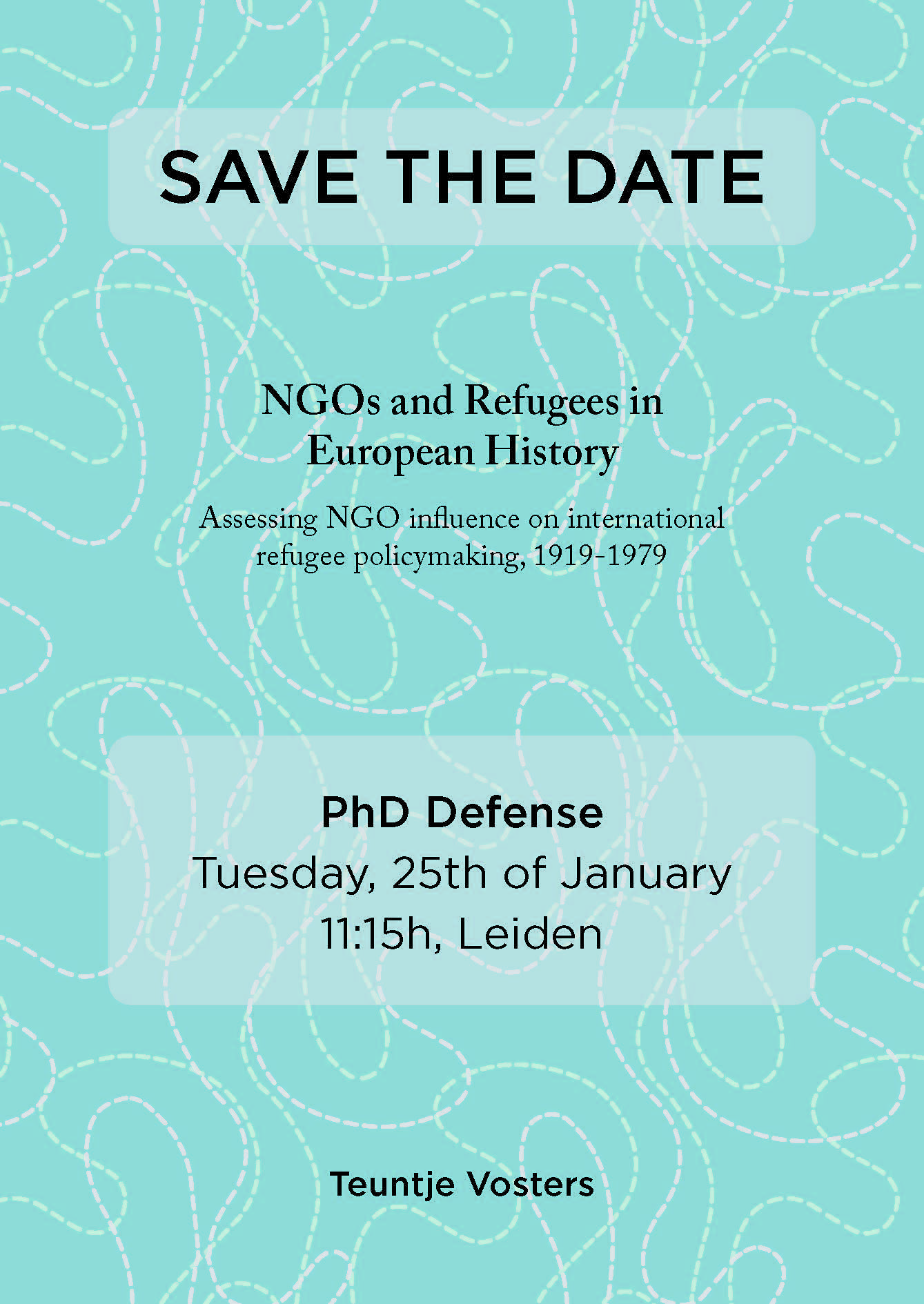
On 25 January 2022 Posthumus alumna (cohort 2016) Teuntje Vosters successfully defended her PhD thesis ‘NGOs and Refugees in European History: Assessing NGO influence on international refugee policy making, 1919-1979’ at Leiden University.
The N.W. Posthumus Institute congratulates Teuntje with this achievement!