Research School for Economic and Social History

Author: René van Weeren

  • Research School Political History Seminar ‘Applied History and Current Affairs’

    Research School Political History Seminar ‘Applied History and Current Affairs’

    On 24 February 2023, the Research School Political History (RSPH) organises the seminar ‘Applied History and Current Affairs’. This seminar has a dual goal. First of all, it invites PhD candidates to reflect on the links between their research project, their research methodologies, and current affairs. Students are asked to rethink the relevance and the methodologies of their project from the perspective of current social and political concerns. What is the ‘big question’ that you are trying to respond to? Second, in interaction with people working in the sphere of policy-making, heritage, the press and think tanks candidates reflect on how they can develop methods of ‘applied history’, how their research can be considered ‘usable history’ for others outside academia, and/or how they may present their academic skills and knowledge to the world beyond academia, also with an eye towards their post-PhD-career.

    Supervisors of and speakers at this seminar will be Dr Harm Kaal, Dr Stefan Couperus and Professor Beatrice de Graaf. PhD participants are expected to write a short statement (1 A4) and a short paper (800-1000 words) to be discussed at this seminar. Details on the content, deadlines and how to submit are to be found in the leaflet (pdf; see button below).

    Participants need to register by e-mail via the secretariat of the RSPH before 2 February 2023. If registration exceeds the group limit, third-year PhD candidates will have priority.

    FULL INFO (DOWNLOAD PDF)

  • Invitation to inaugural address Professor Tine De Moor (Erasmus University Rotterdam)

    Invitation to inaugural address Professor Tine De Moor (Erasmus University Rotterdam)

    The rector magnificus of the Erasmus University Rotterdam announces that Professor Tine De Moor, appointed as professor of Social Enterprises and Institutions for Collective Action at Rotterdam School of Management, Erasmus University (RSM) will publicly accept her appointment on Friday 17 February 2023 with an inaugural lecture entitled Shakeholder society? Social Enterprises, citizens and collective action in the community economy.


    Professors are invited to participate with a gown in the academic procession and are kindly requested to be present from 15:30 hrs on the first floor of the Erasmus (A) Building, near the rector’s room. The ceremony will start promptly at 16:00 hrs in the Aula of the university (Erasmus building), Burgemeester Oudlaan 50 Rotterdam. The reception will take place in the same building afterwards.


    If you are unable to attend, you can also attend the inaugural lecture via livestream.


    The rector magnificus invites you to attend this ceremony and the reception. If you wish to attend the lecture in person, you are kindly requested to register via this link.

    Professor De Moor’s inaugural address will be preceded at 11:00 on the same day by a public seminar with international scholars presenting their research results as solutions to tackle societal challenges. You are asked to register for this event.

    REGISTRATION
     
    LIVESTREAM

  • PhD Defence Sam Geens

    PhD Defence Sam Geens

    On 23 January 2023, Posthumus alumnus Sam Geens succesfully defended his doctoral thesis Een Gouden Eeuw voor arbeid? Inkomen en rijkdom voor en na de Zwarte Dood in de Zuidelijke Nederlanden en de Florentijnse Republiek (1275-1550). Supervisors were Professors Tim Soens, Bruno Blondé, and Peter Stabel

    The Black Death and subsequent plague waves killed millions in the fourteenth and fifteenth centuries. Although these traumatic events unsettled social relations, economic production, and cultural values, scholars have also stressed their positive impact on living standards. Already from the nineteenth century on, scholars have characterised the period as the Golden Age for labour. Yet, some historians have been more sceptical about the evidence. This thesis takes these comments at heart by critically examining income, work time, and wealth to determine the true scope of the Golden Age across time, space, and social groups. Thanks to a comparison between the Republic of Florence and the Southern Low Countries, Geens shows that the plague pandemic did not result in a universal increase in living standards. In the last-mentioned region, the income and wealth of most households reached unprecedented heights because of a type of industrious revolution. In stark contrast, such a positive evolution was absent in the Republic of Florence outside the capital. Here, only the ruling elites were able to increase their fortunes due to protectionist measures, the spread of exploitive forms of urban landownership, and increasing fiscal pressure to finance the many wars.

    We congratulate Sam with this achievement!

    MORE INFO

  • Swedish Research Council awards grant to Dr Daniel Gallardo and Professor Jutta Bolt

    Swedish Research Council awards grant to Dr Daniel Gallardo and Professor Jutta Bolt

    Dr Daniel Gallardo Albarrán (Wageningen UR) and Professor Jutta Bolt (University of Groningen and Lund University) were awarded a research grant of c. 400,000 euro by the Swedish Research Council for their project proposal ‘Unhealthy development: the origins of health inequalities in Sub-Saharan Africa, 1900-1960’. Co-applicant was Dr Jeanne Cillier of Lund University.

    Millions of deaths occur each year from preventable diseases. Most of these deaths occur in Sub-Saharan Africa (henceforth Africa), where many citizens still lack access to basic sanitation and healthcare. In 2015, there were on average only 1.35 hospital beds available per 1,000 people on the continent, and only 24 % of the population had access to clean drinking water. At the same time, variation between countries is immense: Zambia, for example, has more than 4 times the number of hospital beds per population than Benin; and in the Gambia twice as many people have access to basic sanitation services compared to Burkina Faso. The historical roots of these low health-related investments in Africa have long been recognized, yet little care has been taken to understand and explain the differential spread of healthcare across the continent.

    The objective of this project is to investigate the uneven establishment of healthcare and sanitation in colonial Africa, ca 1900-1960. Using largely unexplored primary sources for both former British and French colonies, this research will map and explain the spatial and temporal distribution of healthcare and sanitation infrastructures during the first half of the 20th century, when state-funded healthcare was established on the continent. The project will provide the first-ever comprehensive empirical account of healthcare interventions and outcomes in Sub-Saharan Africa before 1960, thus filling a substantial knowledge gap in comparative studies of historical health inequality.

    PROFILE DR DANIEL GALLARDO
     
    PROFILE PROFESSOR JUTTA BOLT

  • Conference ‘Migration and Societal Change’ – Call for proposals – deadline 5 February 2023

    Conference ‘Migration and Societal Change’ – Call for proposals – deadline 5 February 2023

    The Utrecht University Focus Area Migration & Societal Change welcomes proposals for a panel or an individual paper for the conference ‘Migration and Societal Change’, to be held on 22 and 23 June 2023. The Focus Area promotes interdisciplinary collaboration between Utrecht University researchers, students, and societal stakeholders. Thematically, the focus is on various topics related to migration to and between European countries in the 20th and 21st century. But this theme is placed into a larger historical framework (to include e.g. (post)colonial constellations) and approaches from a transnational perspective that understand Europe as co-constituted by and entangled with other parts of the world. The conference will provide opportunities for researchers from around the globe to present and discuss their work.

    Applicants are welcomed to submit a proposal for a panel consisting of 5 papers maximum, and/or an abstract for an individual paper. Abstracts of papers should have a maximum of 300 words and for panel proposals panel organisers are asked to submit the entire set of abstracts including short bios of presenters. Contributions that address various topics regarding migration and societal change will be accepted.

    Registration for both presenters and non-presenters to the conference is mandatory, but free of charge. You will be able to register your participation from 5th of January 2023. For proposals, please submit your abstract no later than 1 February 2023 by e-mail. By 15 April 2023 all applicants will be notified on whether their proposal has been accepted.

    DONWLOAD CALL AS PDF

  • Summer school Socioeconomic diplomacy and global empire building, 16th-19th centuries – Call for papers – deadline abstracts 15 February 2023

    Summer school Socioeconomic diplomacy and global empire building, 16th-19th centuries – Call for papers – deadline abstracts 15 February 2023

    On 26-28 June, 2023, Leiden University’s Institute for History will host a summer school on Socioeconomic diplomacy and global empire building, 16th-19th centuries, in collaboration with the N.W. Posthumus Institute and the Global Diplomacy Network. The summer school will bring together approximately 10-15 advanced students or young academics and a team of experts at the crossroads of (new) diplomatic history, the history of empires, and global history. We will discuss and present content, historiography, concepts and methodology in these innovative fields. We aim for a stimulating programme consisting of lectures, interactive workshops, and thorough discussions of the participants’ work.

    Themes, discussions and questions

    This summer school will explore the concept of socioeconomic diplomacy in the context of global empire building (16th-19th centuries). The main questions to be assessed are:

    • In the context of empire building, where political and economic aims closely interrelate, how do we distinguish between ‘traditional’ political diplomacy and economic diplomacy? Is there even a distinction?
    • What purposes did socioeconomic diplomacy serve in empires?
    • How applicable are the general historiographical definitions of ‘commercial’, ‘economic’, ‘business’, ‘social’ and ‘cultural’ diplomacy to specifically global contexts?
    • What sources, methodologies and framings are best suited to approach these questions?

    These questions will be explored by comparing cases with a wide temporal, spatial and cultural (western and non-western) spread, to properly gauge the diversity but also commonalities found in socioeconomic diplomacy in empires, and especially the concepts and methodologies to assess it.

    Content

    The summer school will engage with several historiographical debates. Firstly, we touch upon new diplomatic history by moving beyond the political dimension, and also look at the socioeconomic aspects of diplomacy – both socioeconomic diplomacy in itself, and the social and economic effects of ‘political’ diplomatic activity on societies. Secondly, we assess debates in empire formation and stakeholdership, where non-state actors such as entrepreneurs/companies/bankers are increasingly recognized to have assumed a pivotal role at the intersection of the public and the private as contractors and ‘agents’ of imperial power, gaining diplomatic capital in the process. Lastly, we look at more methodological debates on source evaluation in global history, and how to account for fundamental imbalances and biases in western sources, and incorporate other types of sources into the corpus (in this case pertaining to diplomacy).

    Participation

    The summer school is open to 10-15 (advanced) Research Master’s/MPhil students, PhD candidates, and early career scholars. Precedence will be given to applicants affiliated with the N.W. Posthumus Institute or the Global Diplomacy Network.
    The participants will work and discuss the themes together with at least seven distinguished experts on diplomacy in global settings, affiliated with the Global Diplomacy Network. The experts’ specializations vary from imperial China, to the Ottoman empire, to the Spanish Atlantic, and much more. Participation is free of charge and refreshments (lunch/coffee/tea/snacks) will be provided. Participants are expected to make their own travel arrangements.

    How to apply

    Applicants are encouraged to submit a (short) cv and a 500 word abstract of their paper by 15 February 2023. Submissions should be sent by e-mail to Drs Tessa de Boer. Participants will be informed about their selection by the end of February. Accepted participants are expected to write and present a paper of approx. 5,000 words, to be discussed in depth by an expert and the group as a whole. The organisers explicitly encourage contributions of a wide temporal, geographical or type-of-empire spread and are open to different types of contributions: papers with more empirical or methodological discussions are very welcome too.

    Timeline

    • 15 February 2023: deadline for applications
    • 28 February 2023: applicants informed about selection
    • 26 May 2023: paper draft due
    • 26-28 June 2023: summer school

    Contact

    For questions regarding content and/or practical information, please contact the summer school coordinator Drs Tessa de Boer.

    Assessment and accreditation

    Upon completion of the summer school, participants affiliated with the N.W. Posthumus Institute will receive a certificate of participation. Successful participation will merit 4 EC.

    Sponsors

    The summer school is made possible though contributions by the N.W. Posthumus Institute, the Leiden University Fund (LUF, the Dutch Research Council (NWO)and the Linnaeus University Center for Concurrences in Colonial and Postcolonial Studies (Sweden).

    DOWNLOAD CALL AS PDF

  • Publication and database on 16th-century merchants’ letters and merchants’ marks available online

    Publication and database on 16th-century merchants’ letters and merchants’ marks available online

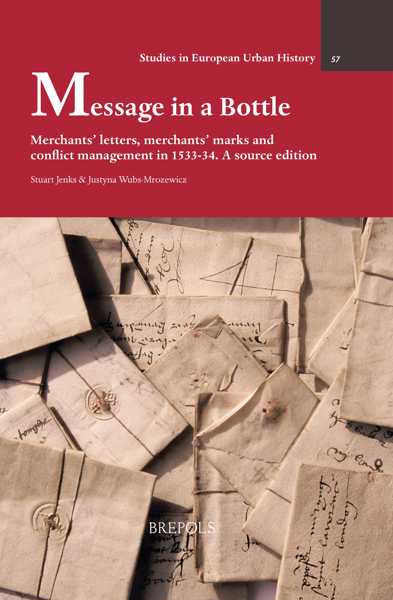
    Posthumus fellow Dr Justyna Wubs-Mrozewicz (University of Amsterdam) and emeritus Professor Stuart Jenks (Friedrich-Alexander-Universität Erlangen-Nürnberg) are the editors of Message in a Bottle: Merchants’ letters, merchants’ marks and conflict management in 1533-34. A source edition, published this fall with Brepols.

    The publication is based on a batch of merchants’ letters to be delivered from Antwerp to London that reached its destination, but ended up as part of a booty taken in the English Channel in August of 1533 by Lübeck privateers, only to be opened again in a Hanseatic archive almost 500 years later. The letters offer a fascinating glimpse into the world of the early 16th century, from hard-nosed business and prices in code sent to a wife, to the fond greetings of an English father to his three young sons or a secretive message of a grandmother from Antwerp. At the backdrop, war was looming: Henry VIII of England exploded with rage and restitution claims were made. Soon after, Lübeck realized the potential political cost of the action and an administrative machinery for the return of the booty was set in motion. Extensive documentation was produced under the eye of notaries, providing an overview of properties of the involved parties, including many merchant marks. The combination of unique letters and administrative documents offers new openings into the study of economic, political and social history of pre-modern northern Europe.

    The book is available as open access online publication with Brepols. In addition, the database this publication is based on, is also available online.

    PUBLICATION
     
    DATABASE

  • Valedictory speech Professor Kees Mandemakers

    Valedictory speech Professor Kees Mandemakers

    Posthumus fellow emeritus Professor Kees Mandemakers, professor of Large Historical Databases at Erasmus School of History, Culture and Communication, will present his public valedictory lecture on Friday 20 January 2023, entitled ‘“You Really Got Me”. Development and Future of Historical Databases with Microdata’.

    The ceremony will begin at 16:00 hours promptly in the Aula, Erasmus (A) building, of the Erasmus University Rotterdam. If you are unable to attend in person, you can also watch the valedictory lecture via livestream. The reception will take place in the same building afterwards.

    LIVESTREAM

  • New book publication by Maarten Prak and Jan Luiten van Zanden

    New book publication by Maarten Prak and Jan Luiten van Zanden

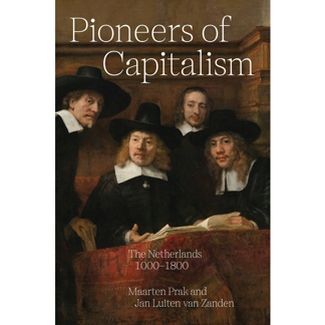
    Posthumus fellows Emeritus Professors Maarten Prak and Jan Luiten Zanden have published a new book with Princeton Universiyt Press, entitled Pioneers in Capitalism: The Netherlands 1000-1800.

    The Netherlands was one of the pioneers of capitalism in the Middle Ages, giving rise to the spectacular Dutch Golden Age while ushering in an era of unprecedented, long-term economic growth across Europe. Pioneers of Capitalism examines the informal institutions in the Netherlands that made this economic miracle possible, providing a groundbreaking new history of the emergence and early development of capitalism.

    Drawing on the latest quantitative theories in economic research, Maarten Prak and Jan Luiten van Zanden show how Dutch cities, corporations, guilds, commons, and other private and semipublic organizations provided safeguards for market transactions in the state’s absence. Informal institutions developed in the Netherlands long before the state created public safeguards for economic activity. Prak and van Zanden argue that, in the Netherlands itself, capitalism emerged within a robust civil society that constrained and counterbalanced its centrifugal forces, but that an unrestrained capitalism ruled in the overseas territories. Rather than collapsing under unrestricted greed, the Dutch economy flourished, but prosperity at home came at the price of slavery and other dire consequences for people outside Europe.

    Pioneers of Capitalism offers a panoramic account of the early history of capitalism, revealing how a small region of medieval Europe transformed itself into a powerhouse of sustained economic growth, and changed the world in the process.

    PUBLISHER’S PAGE

  • 5th Conference Of The European Society Of Historical Demography

    5th Conference Of The European Society Of Historical Demography

    From the prehistorical migrations to our globalized world, humankind has always been confronted with “others”, who are spontaneously compared to “us”. First, it usually implies a fascination for differences, often – but not always followed by a discovery of commonalities. Demographic thought has been, and still is, heavily influenced by the Malthusian discourse that insisted on the differences be-tween Europeans and the others, and the superiority of the former over the latter. Conversely, almost two centuries later the nuclear hardship theory suggested a greater efficiency of the complex family systems over the nuclear model predominant in Europe. It is now time for new approaches that challenge the past narratives. New approaches that, instead of binary oppositions and hypothetical hierarchies, consider equally similarities and dissimilarities, recognize the ambiguity of borders, reciprocal influences, and the importance not only of external but also internal diversity within the compared populations. Ultimately such studies contribute to a better understanding of demographic regimes and family dynamics.

    With this in mind, the 5th ESHD conference leading theme is ‘The Challenge of Comparing Across Space and Time’. Participants are encouraged to engage with and link across three different streams of historical social science analysis:

    • Data and methods for comparative approaches in historical demography and family history
    • Benefits and pitfalls of comparisons
    • The diversity of demographic behaviours and Family dynamics across space and time

    FULL INFO