A new research portal on the origins of global health inequality, Long-Run Health Matters, has been launched. This project provides an open-access meeting point in which leading experts summarize their latest work to those interested in the topic, in an accessible way. Ultimately, this material is intended to foster an informed dialogue about pressing health issues with an impact on both historical and current societal challenges. You are invited to visit this portal website at www.lrhmatters.com and read articles tackling a set of diverse topics such as colonialism and mortality, the modernization of health in the Netherlands or the consequences of industrialization. To remain updated about future posts you can subscribe to the LRHM Newsletter. If you are interested in contributing to the project you can send an email to Daniel Gallardo.
Author: René van Weeren
-
Posthumus fellows involved in TV series on History of the Netherlands
Forthcoming Wednesdays at 20:30, starting 2 February 2022, the NTR will broadcast the Het verhaal van Nederland TV series about the history of the Netherlands (in 10 episodes). Several renowned historians have contributed to this, among whom several Posthumus fellows: emeritus Professor Maarten Prak (episode Geuzen en papen), Professor Oscar Gelderblom (episode Kapers en kooplui), and Professor Elise van Nederveen-Meerkerk (episode Pioniers en paupers).
Next to the series episodes, the related website also contains podwalks, podcasts, and a childrens’ version of these episodes.
-
Workshop ‘A Tapestry of Rules’
~ Please note this event has been rescheduled from its original dates in April 2022 to 30 June-1 July 2022 ~
On 30 June and 1 July 2022, Dr Kate Frederick, affiliated with the Research Group Economic and Social History at Utrecht University will organise the Workshop ‘Tapestry of Rules: This Institutions and Cloth Industries in Global Comparative Perspective, 1750-2000’. This workshop specifically explores the role of formal and informal institutions – the social, economic, political, and cultural “rules of the game” – in influencing textile manufacturing in different world regions over time, with particular reference to the interlinking relationships between institutions and other explanatory variables.
Traditions of textile manufacturing have developed in nearly all parts of the globe. However, the characteristics and development trajectories of these industries have differed markedly over time and across space. The global centre of manufacturing gravity has shifted from East to West and back again over the past three centuries, while in some cases, handicraft industries have persisted, but industrialization has long remained elusive. Scholars like Williamson, Pomeranz, and Mokyr have pointed to a number of key explanatory factors that have influenced temporally and geographically divergent industrial developments, including market forces, resource endowments, and institutions.
This workshop encourages temporal and geographic comparisons and welcomes contributions from scholars studying all parts of the globe. This workshop forms part of the ERC project Race to the bottom? Family labour, household livelihood and consumption in the relocation of global cotton manufacturing, ca. 1750-1990.
-
WORCK Training School – Rewriting Labour Histories: Perspectives from the Globe
The WORCK Training School will bring together 20-25 MA and PhD students from all over Europe during a 5-day program. The program includes lectures from international scholars, roundtables, and seminars. They will focus on theoretical and methodological issues as well as on the implementation of digital methods in research. An important part of the programme is reserved for a Student Conference with comments from senior researchers.
Full info -
Historicidagen 2022 – ‘Grenzeloze Geschiedenis’ / Historians’ Days 2022 – ‘History Beyond Borders’
From 25 until and including 27 August 2022, the annual Historicidagen will be held in Rotterdam. The Historians’ Days are jointly organized by the Royal Netherlands Historical Society (KNHG) and the History Department of the Erasmus University Rotterdam (EUR), are meant for everyone interested in history, professionally or otherwise.
The event showcases the many diverse and dynamic ways of doing history. Through a wide spectrum of lectures, debates and workshops, the Historians’ Days tackles issues and challenges on the frontline of historical research and public debates.
The Historians’ Days 2022 evolve around the theme of History Beyond Borders, and actively promote diversity within participants, audience, program, stories, methods and presentations.
-
Radio-interview met Wouter Ryckbosch in ‘De Wereld van Sofie’
~due to scope, only in Dutch ~
Op 17 januari 2022 werd Wouter Ryckbosch, economisch en sociaal historicus aan de Vrije Universiteit Brussel en algemeen bestuurslid van het N.W. Posthumus Instituut geïnterviewd voor het programma ‘De Wereld van Sofie’ op de Vlaamse radiozender Radio 1. In deze uitzending kwamen onder andere aan bod de vraag of we vanuit de historie bezien hard werken altijd even hard gewaardeerd hebben en daarop aansluitend de vraag of er een evolutie in ons arbeidsethos te ontdekken valt.
-
Expert Meeting Sport, Migration, Citizenship, ‘Race’ and National Identity: Towards a new research agenda
~ Please note that this event has been postponed from its original dates in February to 23-24 June 2022 ~
On 23 and 24 June 2022, the Erasmus School of History, Culture and Communication (Erasmus University Rotterdam) organises an Expert Meeting ‘Sport, Migration, Citizenship, ‘Race’ and National Identity: Towards a new research agenda’. This meeting is supported by the Research Network ‘Routes and Roots in Colonial and Global History’ of the N.W. Posthumus Institute, the Sport and Nation network and the Football and Race network.
Sport and Nation
In the international sports arena, the legal guidelines and the moral justifications for citizenship and national belonging are stretched. By taking high profile examples from international sports events, the Sport and Nations network seeks to unveil the complexities behind the question: who may represent the nation? While the presence of foreign-born athletes in national football teams and the Olympics has a long history, it is often believed that the World Cup and the IOC have become more migratory over time. The presumed increases in the volume and diversity of foreign-born athletes and footballers have, however, remained empirically untested. In this research, it is empirically tested whether the presence of athletes at the World Cup and IOC has increased over time.
The aim of this meeting is threefold:
- To present the major research-results of the Sport and Nation network of the last five years.
- To present some of the major results from football and race scholars and the Football and race network
- To look for opportunities to move on in this research arena
Football and race
During the EURO 2020 some national teams have been kneeling to protest against racism in football and to show support to the Black Lives Matter movement, reminding us of the urgency to address issues of racism in sport. Given the racial, ethnic and national diversity of football players in men’s and, to a lesser extent, women’s football, together with its large audiences, it is important to provide more insights into how football contributes to meaning making processes related to race and ethnicity. Existing research has shown, for instance, that football commentators sometimes use racial/ethnic stereotypes when describing or talking about football players. In so doing, they reproduce larger societal discourses about race/ethnicity that sustain racial inequality. The ‘football and race network’ at Erasmus University is exploring the (re)production of discourses surrounding race and ethnicity within football, with a specific focus on the role of media and leadership and coaching, within a European perspective in particular. They do so from a critical perspective. Findings need to be placed in a wider academic and societal debate on race, popular culture and multi-ethnic society.
Programme
The full programme can be found online via this link.
How to register
The organisers invite respected and outstanding scholars to discuss the state of the art of sport and social sciences/humanities studies and look at the future. Registration is possible via the conference website.
-
PhD Defence Amaury de Vicq de Cumptich (Utrecht University)
On 14 January, Posthumus-alumnus Amaury de Vicq de Cumptich successfully defended his dissertation ‘Exploring the Dynamics of Small and Local Financial Institutions. The Case of the Netherlands, c.1860-1940. Small and medium-sized enterprises’ at Utrecht University. The N.W. Posthumus Institute congratulates Amaury with this achievement.
Amaury’s research deals with the developments of the Dutch financial system from the mid-19th to the beginning of the 20th century. Unlike previous research, this study focuses primarily on the financing of small and medium-sized enterprises. Small and medium-sized enterprises (SMEs) continue to be one of the drivers of economic growth, accounting for 60% to 70% of employment and 55% of GDP in more developed economies. It is therefore essential to provide SMEs with better access to business finance and thus enable them to realize their full potential. This dissertation studies how financial institutions met this capital need in the past and what lessons can be learned for the present.
Promotors were Professor Oscar Gelderblom and Professor Joost Jonker.
-
Impression PhD Seminar I – ‘My project in a nutshell’
The COVID-19 situation unfortunately urged us to turn the first seminar of the Basic Training into an online event. Notwithstanding this disappointment, sixteen PhD students, seven fellows and two PhD representatives joined the online two-day seminar with interesting presentations and fruitfull discussions.
On Thursday, after introductions by Rogier van Kooten (Education Programme Director) and Jasper Segerink (PhD representative), Wouter Ryckbosch, director of HOST research group (VUB) gave an interesting lecture on research methodology. During the first afternoon and the second day, the PhD students introduced their research and received comments from colleagues and senior commentators.
We also found out that the 2021 cohort members form a very diverse group with group members ranging from musical to very sporty candidates. A good atmosphere and constructive approach are typical of the Posthumus programme, supporting PhD students on their way to a successfull thesis.
We are already looking forward to the second seminar in Brussel (28-29 April), hopefully this time in person!
Rogier van Kooten
Education Programme Director
N.W. Posthumus Institute -
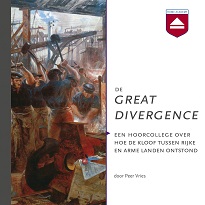
Podcast ‘De Great Divergence’ door prof. dr. Peer Vries
~ because of scope, only in Dutch ~
Recent is in de Home Academy-reeks de podcast ‘De Great Divergence‘ van prof. dr. Peer Vries verschenen, een zesdelig hoorcollege over dit historisch economisch uiteengroeien . De meeste experts zijn het erover eens dat de Great Divergence ergens in de achttiende en negentiende eeuw ontstond, toen voor het eerst in de geschiedenis van de wereld in Groot-Brittannië en in een aantal andere Europese landen moderne economische groei optrad. Tot op dat moment was het verschil tussen arme en rijke samenlevingen altijd relatief gering geweest, aangezien wereldwijd armoede normaal was. Met de Great Divergence werd het westen veel rijker dan de rest van de wereld, met uitzondering van Japan.
In zijn college bespreekt academisch expert prof. dr. Peer Vries een groot aantal zeer diverse verklaringen voor dit economisch uiteengroeien. Hij doet dit aan de hand van systematische vergelijkingen van allerlei verschillende delen van de wereld, met accent op West-Europa en Oost-Azië. Het te verklaren fenomeen is weliswaar economisch van aard, maar bij de verklaringen krijgen ook geografische, demografische, politieke, militaire, sociale en culturele factoren ruime aandacht.
Over de auteur
Prof. dr. Peer Vries studeerde economische en sociale geschiedenis aan de Universiteit Leiden. Momenteel is hij Honorary Research Fellow aan het Internationaal Instituut voor Sociale Geschiedenis te Amsterdam. Hij is lid van de Academia Europaea en was mede-oprichter van het Journal of Global History en van het Global Economic History Network.
Bestelpagina