Research School for Economic and Social History

Blog

  • PhD Career Day 2025 – register before 1 November 2025

    PhD Career Day 2025 – register before 1 November 2025

    The Research School Political History, the N.W. Posthumus Institute, the Huizinga Institute, and the Research School for Medieval Studies warmly invite PhD candidates and recent graduates to the PhD Career Day 2025. This event will be at the IISH in Amsterdam.

    This day offers an inspiring programme with speakers who all hold a PhD in history and have built careers across a wide variety of sectors. They will share their insights on life after the PhD. Many of them are alumni of the organising research schools and can speak from personal experience about the opportunities, choices, and challenges facing early-career historians.

    Participation is free of charge, but because of catering and room capacity prior registration is requested ultimately by 31 October 2025.

    MORE INFO
     
    REGISTRATION

  • Successful PhD defence Posthumus alumnus Alberto Concina

    Successful PhD defence Posthumus alumnus Alberto Concina

    On 29 September 2025, Posthumus alumnus Alberto Concina successfully defended the thesis ‘Tilting the scale of life: A multidimensional study of living standards between peasant and rural market societies in North-Western Italy, 1650-1800’ [transl.: ‘Herkalibratie van de weegschaal van het leven. Een multidimensionele studie van de levensstandaarden in rurale “peasant” en markteconomieën in Noord-West-Italië, 1650-1800’] at the KU Leuven. Supervisor was Professor Maïka De Keyzer.

    Alberto’s research aims to test whether economic growth had a positive influence on prosperity levels in the past. Growth has long been seen as a precondition for high prosperity. However, through the use of GNP figures and real wages, indicators that only record commercial transactions, commercialized companies with economic growth will automatically emerge as more prosperous. By developing a new multidimensional prosperity index, to measure all essential dimensions of prosperity of different types of historical societies, Alberto’s research aims to be the first to perform a systematic comparison of the prosperity levels of two fundamentally different societies on the two sides of the growth spectrum that coexisted in Piedmont during the early modern period. They will be studied from a long-term perspective (1650-1800), to test what kind of society was able to develop and maintain the highest overall levels of prosperity in the long term.

    The N.W. Posthumus Institute congratulates Alberto with this successful defence!

    MORE INFO

  • Jaarsymposium Vereniging Gelre ‘Maakbare boeren en boerinnen?’ – deadline aanmelding 22 oktober 2025

    Jaarsymposium Vereniging Gelre ‘Maakbare boeren en boerinnen?’ – deadline aanmelding 22 oktober 2025

    ~ because of scope in Dutch only ~

    Op vrijdag 31 oktober organiseert de Vereniging Gelre haar jaarlijkse symposium. Met dit symposium wil Vereniging Gelre historische context bieden bij de huidige debatten over de landbouwsector. Het thema van dit jaar luidt: ‘Maakbare boeren en boerinnen? Landbouw en platteland in Gelderland tijdens de wederopbouwjaren’.

    Tijdens de wederopbouw tachtig jaar geleden werd de landbouw, zeker op de kleine bedrijven op de zandgronden, als achterhaald en inefficiënt beschouwd, en de woonomstandigheden als onacceptabel. Landbouw en platteland moesten vernieuwd worden. Dat gebeurde door ruilverkaveling en mechanisatie om zo de productiefactoren efficiënter te maken. Maar ook de mensen moesten veranderen, ze moesten hun ‘traditionele’ ideeën opgeven en gevormd worden tot moderne burgers. De boerenbevolking werd als maakbaar beschouwd, zoals historicus Erwin Karel het heeft uitgedrukt.

    Op het symposium wordt ingegaan op de middelen die werden ingezet om dat doel te bereiken, zoals landbouwvoorlichtingsfilms en landbouwhuishoudonderwijs, en op verzet tegen de modernisering, zoals bij de discussies over doelmatige boerderijbouw. Dit offensief was uiteindelijke succesvol en de gevolgen ervan zijn nog steeds merkbaar: een hoogproductieve landbouwsector, die helaas ook vervuilend is, en moeilijk te veranderen.

    Het symposium zal plaatsvinden bij Wageningen Universiteit & Research. Sprekers zijn Peter Veer (landschapsarchitect en audiovisueel programmamaker), Sophie Elpers (onderzoeker etnologie bij het Meertensinstituut en hoogleraar Immaterieel Erfgoed en Etnologie aan de Universiteit Antwerpen), Jeanne van Poppel (oral history onderzoeker) en Piet van Cruyningen (senior onderzoeker Landbouwgeschiedenis Wageningen University & Research).

    Aanmelden voor dit symposium kan tot uiterlijk 22 oktober per e-mail. Er geldt een toegangsbijdrage, voor studenten is de toegang gratis.

    MEER INFO

  • Successful Phd Defence Posthumus alumnus Jurriaan Wink

    Successful Phd Defence Posthumus alumnus Jurriaan Wink

    On 22 September 2025, Posthumus alumnus Jurriaan Wink successfully defended the PhD thesis ‘Het thuisfront springt bij: Stad, gewest en vorst op de bres voor kooplieden uit Kampen, Utrecht en Zutphen in den vreemde (ca. 1440-1560)’ [transl. ‘Help from home: Urban, regional, and central authorities of Kampen, Utrecht, and Zutphen supporting merchants abroad (ca. 1440-1560)’]. Supervisors were Professor Bart Lambert (Vrije Universiteit Brussel) and Professor Louis Sicking (VU Amsterdam).

    Trade in the late Middle Ages was risky business: travel was slow, information often incomplete, and danger never far away. Yet international trade continued to grow. Why did merchants and skippers keep following their trade routes despite the risks? Previous research has mainly approached trade as a relationship between merchants and the authorities at their destination. This thesis shifts the focus: to the practical, diplomatic and legal support merchants and skippers from Kampen, Utrecht and Zutphen received abroad from their home cities and rulers: their home front. It shows that research demonstrates that international trade was never just a matter between a merchant and their destination and the home front was a key factor in long-distance trade, alongside the efforts of merchants themselves and the provisions offered by foreign authorities.

    The N.W. Posthumus Institute congratulates Jurriaan with the successful defence!

    THESIS INFO

  • Najaarsbijeenkomst 2025 SGvdO in teken 80-jarig bestaan FIOD

    Najaarsbijeenkomst 2025 SGvdO in teken 80-jarig bestaan FIOD

    ~ because of scope in Dutch only ~

    Op 4 november 2025 organiseert de Stichting Geschiedenis van de Overheidsfinanciën (SGvdO) de Najaarsbijeenkomst 2025, die in het teken zal staan vanm het tachtigjarig bestaan van de Fiscale Inlichtingen- en Opsporingsdienst (FIOD).

    Naast aandacht voor de geschiedenis van de FIOD zal er aandacht zijn voor de rol van onderzoeksjournalistiek in fraudebestrijding. Sprekers zijn Leo Boer (voormalig programmamanager FIOD Onderzoek), Jan Molenaar (specialist anti-witwaspraktijken van de FIOD) en Bart de Koning (onderzoeksjournalist en docent aan de Politieacademie).

    Deelname is gratis, maar aanmelding vooraf per e-mail is wel nodig.

    MEER INFO

  • Successful PhD Defence Posthumus alumnus Sander Berghmans

    Successful PhD Defence Posthumus alumnus Sander Berghmans

    Recently we were informed that earlier this year, 21 March 2025, Posthumus alumnus Sander Berghmans successfully defended the thesis ‘Dukes and abbots: essays on the economics of estate management in the Southern Netherlands (ca. 1600-1820)’ at Ghent University. Supervisors were Professors Thys Lambrecht, Koen Schoors, and Erik Thoen (all Ghent University).

    The historiography concerning the economy of rural societies in the Southern Netherlands—and that of Europe in general—has received significant attention from researchers in recent years. Earlier research on this theme primarily focused on major economic movements such as the evolution of food, labor, and land markets, as well as social phenomena like inequality. While such research is crucial for understanding early modern society, it often lacks deeper insight into the mechanisms behind these evolutions: What drove people in a certain position to make specific economic choices and thus contribute to broader economic processes? This dissertation specifically examines the management (which can be seen as an economic choice) of the estates of large landowners. In Sanders’ research, three key factors influencing management are considered: the organization of property, the socio-economic environment, and short-term economic fluctuations. This was done through case studies of three large landowners: the Dukes of Arenberg, the Abbey of the Dunes (Roosewalle), and Abbot De Loose of Ename. This dissertation demonstrates that management decisions could have a significant impact on the local population. However, these decisions were made in relation to the local population and could sometimes lead to a form of counterreaction. At the same time, the choices available to landowners were largely path-dependent. Furthermore, this dissertation shows that the direct exploitation of part of the land was more common than previously assumed. It appears that landowners consistently aimed for maximum personal revenue rather than the highest production, which would have been more beneficial for the population. Finally, this dissertation addresses the criticism that research on the principal-agent relationship is ahistorical, acontextual, and static by employing the historical method.

    The N.W. Posthumus Institute congratulates Sander with this achievement!

  • NEHA Symposium ‘Naar een meer inclusieve economische- en bedrijfsgeschiedenis’

    NEHA Symposium ‘Naar een meer inclusieve economische- en bedrijfsgeschiedenis’

    Op 28 november 2025 organiseert het Nederlands Economisch-Historisch Archief (NEHA), in samenwerking met de Stichting Bedrijfsgeschiedenis (BSG), een bijeenkomst met als thema ‘Naar een meer inclusieve economische en bedrijfsgeschiedenis’.

    Deze bijeenkomst vindt plaats bij het Internationaal Instituut voor Sociale Geschiedenis (IISG) in Amsterdam en krijgt de vorm van een symposium, met onder meer een publiekslezing door prof. dr. Jan Hein Furnée (hoogleraar Cultuurgeschiedenis aan de Radboud Universiteit en voorzitter van het Koninklijk Nederlands Historisch Genootschap (KNHG)), en bronnentafels met een aantal prachtige voorbeeldcollecties.

    Deelname is gratis, maar aanmelding vooraf per e-mail wordt gevraagd.

    MEER INFO

  • Successful PhD Defence Posthumus alumnus Joris Kok

    Successful PhD Defence Posthumus alumnus Joris Kok

    On 18 September 2025, Posthumus alumnus Joris Kok succesfully defended the thesis ‘Social Mobility and Integration of Amsterdam Jews: The Ethnic Niche of the Diamond Industry, 1850-1940’ at Leiden University. Supervisors were Professor Leo Lucassen and Professor Karin Hofmeester (both IISH).

    In his dissertation, Joris studies the remarkable social mobility and varied integration patterns of Jews in pre-war Amsterdam, with a particular focus on Jewish diamond workers, who formed the community’s occupational and cultural core. Drawing on uniquely detailed life-course data and a comparative perspective, it demonstrates that Jews, on average, advanced in occupational status and educational attainment faster than non-Jews, surpassing them by the early twentieth century. This upward trajectory was especially striking among diamond workers, whose high wages, strong labour organisation through the founding of the first modern union in the Netherlands, and commitment to education created novel opportunities for men and women alike. The study is the first to examine Dutch-Jewish workers’ social mobility across multiple life domains—work, marriage, residence, and education—within a comparative perspective that includes Gentile counterparts. It highlights, in particular, the exceptional intergenerational gains achieved by Jewish families connected to the diamond industry. Additionally, it demonstrates that upward social mobility and integration did not necessarily coincide and sometimes diverged: despite their increasing social status, Jewish diamond workers were considerably less likely to marry non-Jewish partners or disaffiliate religiously.

    The N.W. Posthumus Institute congratulates Joris with this achievement!

    STREAMING VIDEO

  • Workshop ‘Human Development and Its Outliers’

    Workshop ‘Human Development and Its Outliers’

    The organisers of the Workshop ‘Human Development and Its Outliers’ welcome abstract for papers to be presented at this workshop, to be held on 26 and 27 March 2026 at Leiden University. The workshop forms part of the project ‘Human Development and Its Outliers: A Global Microhistory’, funded by a starters’ grant of the Dutch Government.

    The workshop brings together scholars working on the history of human development, inequality, and exceptional cases or ‘outliers’ that challenge dominant patterns. The organisers invite contributions that explore these themes from a variety of perspectives, including economic, social and demographic history.

    Abstracts (300-400 words max.) should be submitted ultimately 1 November 2025 via e-mail to Dr Brianne Wesolowski.

    FULL INFO

  • Lindert-Williamson Prize awarded to Posthumus fellow Maanik Nath

    Lindert-Williamson Prize awarded to Posthumus fellow Maanik Nath

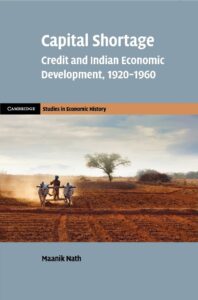
    cover book Capital Shortage by Maanik Nath

    At the 85th Annual Meeting of the Economic History Association, held in Philadelphia, PA (USA) on 5-7 September 2025 the biannual Peter Lindert-Jeffrey Williamson Prize was awarded to Dr Maanik Nath, fellow of the N.W. Posthumus Institute and assistant professor in Economic History at Utrecht University for his publication Capital Shortage: Credit and Indian Economic Development, 1920–1960 (Cambridge University Press, 2023). The Peter Lindert-Jeffrey Williamson Prize is awarded every other year for an outstanding Book in Global, African, Asian, Australian, and/or South American Economic History.

    In this book Maanik Nath researches the causes of persistent poverty in the population of India in colonial and postcolonial times. He finds that the pervasive high cost and shortage of capital affected the peasant’s ability to invest in land. The productivity of land, as a result, remained small and changed little. Bridging economic theory and historical evidence, Capital Shortage shows that climate, law, policy design, and interactions between these factors, perpetuated a stubborn cycle of low investment and widespread deprivation over several decades. These findings can be tested against credit and development in preceding and succeeding periods as well as positioned in comparative global context.

    In 2024, Maanik already also received the First Monograph Prize in Economic and/or Social History, awarded by the Economic History Society, for the same publication.

    The N.W. Posthumus Institute congratulates Maanik with this award!

    BOOK INFO