Research School for Economic and Social History

Blog

  • Summer Training School ‘Research on health inequalities using longitudinal demographic data’ (Lund University)

    Summer Training School ‘Research on health inequalities using longitudinal demographic data’ (Lund University)

    In collaboration with the European Society for Historical Demography, the COST-Action Great Leap organises a summer training school on ‘Research on health inequalities using longitudinal demographic data’. It equips students with theories, sources and methods for analyzing inequalities in health. The course provides hands-on workshops in data management of longitudinal micro-level data, event-history analysis, and analysis of causes of death. In addition, a large part of the summer school is devoted to a team project.

    Students interested in joining this Training School are expected to be familiar with demographic and quantitative methods, historical micro-level data, and have at least intermediate level econometrics. Applicants should be enrolled in a PhD program, have recently received their PhD, or be enrolled in a MSc program.

    Applications for attending this Student Training School should be submitted via e-mail ultimately 1 April 2024. The e-mail contact address as well as specification of the required application documents can be found in the full call, to be downloaded as pdf via the button below. Please note that a participation fee applies.

    DOWNLOAD FULL CALL (PDF)

  • Kick-off Meeting of the COST-Action ‘The Great Leap’

    Kick-off Meeting of the COST-Action ‘The Great Leap’

    The network coordinators of the COST-Action initiative ‘The Great Leap. Multidisciplinary approaches to health inequalities, 1800-2022’, led by Radboud University, invite all stakeholders and all those interested to join the (hybrid) kick-off meeting of this initiative on 2 May 2024.

    ‘The Great Leap’ has been selected by the European Cooperation in Science and Technology (COST) to undertake a comprehensive exploration of the historical origins and driving factors behind health inequalities across regions and countries in Europe and beyond. The network connected to ‘The Great Leap’ includes a wide range of academic expertise in history, social sciences, life sciences and epidemiology and involves university-, research-, government- and (international) health institutes and organizations, including statistical offices and national archives. Aim of ‘The Great Leap’ is to foster collaboration, share insights, and catalyse action in addressing pressing health disparities through providing a historical long-term perspective via five consecutive subprojects.

    Attending the kick-off meeting is open to all interested, but prior registration is requested. You can register by e-mail via Dr Marieke van Egeraat at Radboud University.

    MORE INFO

  • PhD Workshop ‘Writing history in the Anthropocene’ by Professor Sandra Mass

    PhD Workshop ‘Writing history in the Anthropocene’ by Professor Sandra Mass

    Professor Peter van Dam (University of Amsterdam) and Dr Mario Daniels (Duitsland Instituut Amsterdam), in cooperation with the German Academic Exchange Service (DAAD, Deutsche Akademischer Austauschdienst) jointly call for PhD papers for a PhD Workshop with Professor Sandra Mass (Ruhr-Universität-Bochum).

    While geographers have debated for quite some time whether the Anthropocene as a geological epoch started 500, 250, or just 70 years ago, historians have only just begun to notice the epoch. Broadly defined as the era in which humans have come to constitute a geological force capable of impacting the global climate, the concept among other things challenges us to rethink the ways in which historical actors related to their environment, to people in other parts of the world, and to reconsider the timescales in which we situate our histories.

    How do we relate to the Anthropocene in our scholarship? Does the concept inspire or terrify us? Do we employ it as a conceptual framework, a loose collection of questions, or as a counterpoint to our own approach? During this workshop, it will be explored what the Anthropocene means to us in writing histories, thus probing what it means to write history at this moment of confluence of many environmental crises, to what extent present concerns productively inform our work.

    Participants of this workshop are inivited to reflect on the ways in which their work grapples with these problems and questions. The workshop takes its cue from the work of Sandra Mass, Professor of Transnational History at the Ruhr-Universität Bochum. She will present insights from her upcoming book Clio contaminated: Geschichtsschreibung im Anthropozän. Participants whose work implicitly considers the concerns which come to the fore around the notion of the Anthropocene or explicitly addresses the concept of the Anthropocene are welcome to apply. The workshop will be centered around the discussion of pre-circulated papers (no more than 5000 words) which will be due on April 16.

    If you are interested in participating, please send a title and a short outline of the paper you would like to present by e-mail to Professor Peter van Dam.

    The workshop will be hosted in conjunction with a lecture on ‘Writing history in the Anthropocene’ by Professor Sandra Mass on the preceding day, 25 April 2024, 17:00-19:00 at the academic-cultural podium Spui 25 (Spui 25, 1012 WX Amsterdam).

    DOWNLOAD CALL (PDF)
  • Succesful PhD defence Posthumus alumna Ophelia Ongena

    Succesful PhD defence Posthumus alumna Ophelia Ongena

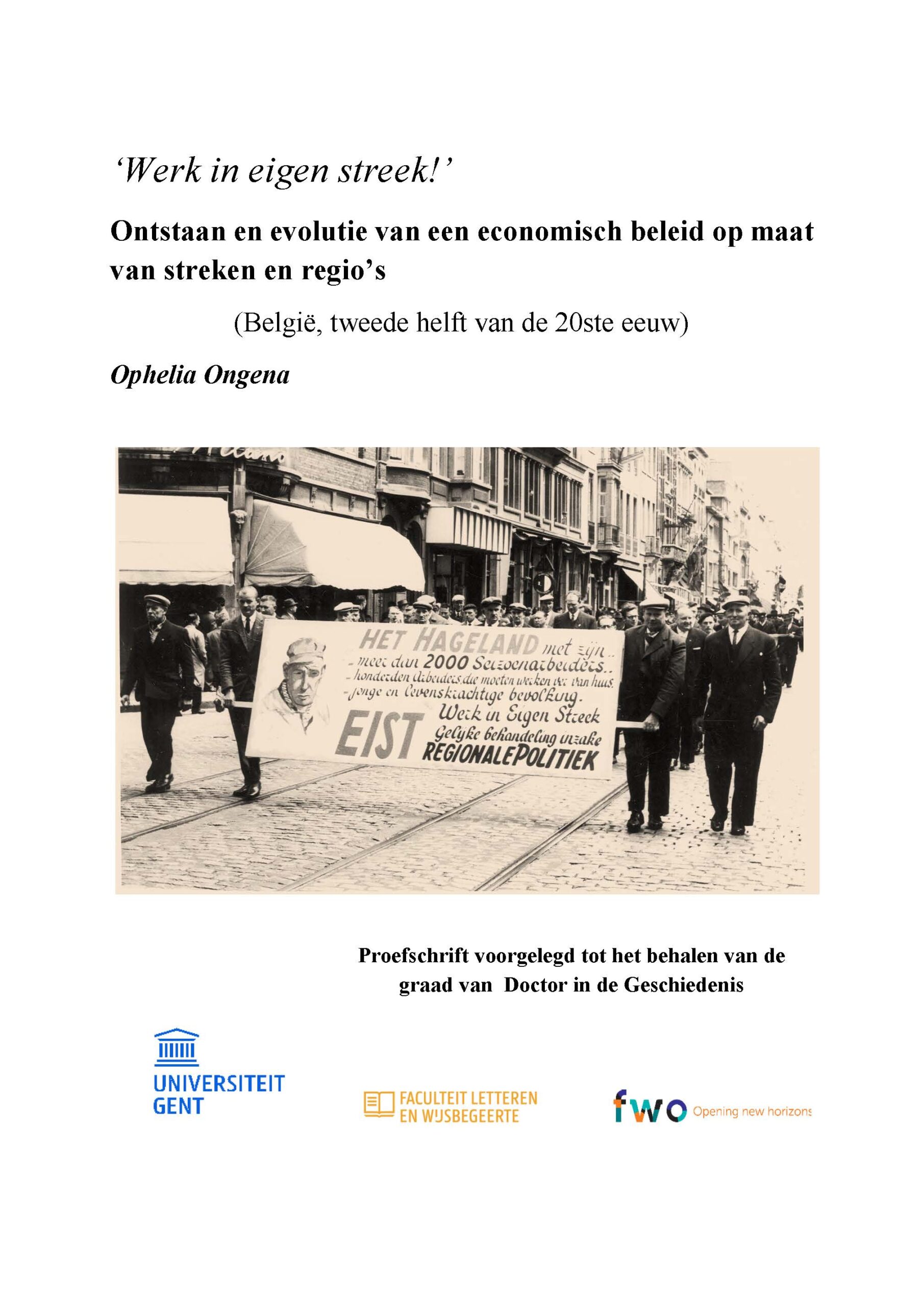
    On 16 February 2024 Posthumus alumna Ophelia Ongena succesfully defended her PhD thesis ”Werk in eigen streek!’ Ontstaan en evolutie van een economisch beleid op maat van streken en regio’s (België, tweede helft van de 20ste eeuw)’ at Ghent University. Promotors were Professor Eric Vanhaute (Ghent University) and Dirk Luyten (CegeSoma).

    In her research, Ophelia looked how the regional economic policy strategies were interpreted by policy makers, from local/sub-regional governments to the European policy level that became increasingly important in defining regional policy lines. She also studied which political strategies have tightened or weakened those policy, to what results they led to and which actors (with or without a political mandate) played an important role in it. By reconstructing the different policy strategies and visions, each with its own long-term emphasis and underlying ideas, certain fault lines and/or continuities became visible, which gave us a nuanced picture of the most important shifts and policy mechanisms.

    We congratulate Ophelia with this achievement.

    MORE INFO

  • Conference ‘Feeding the citizens? Urban land and landownership in past and present’

    Conference ‘Feeding the citizens? Urban land and landownership in past and present’

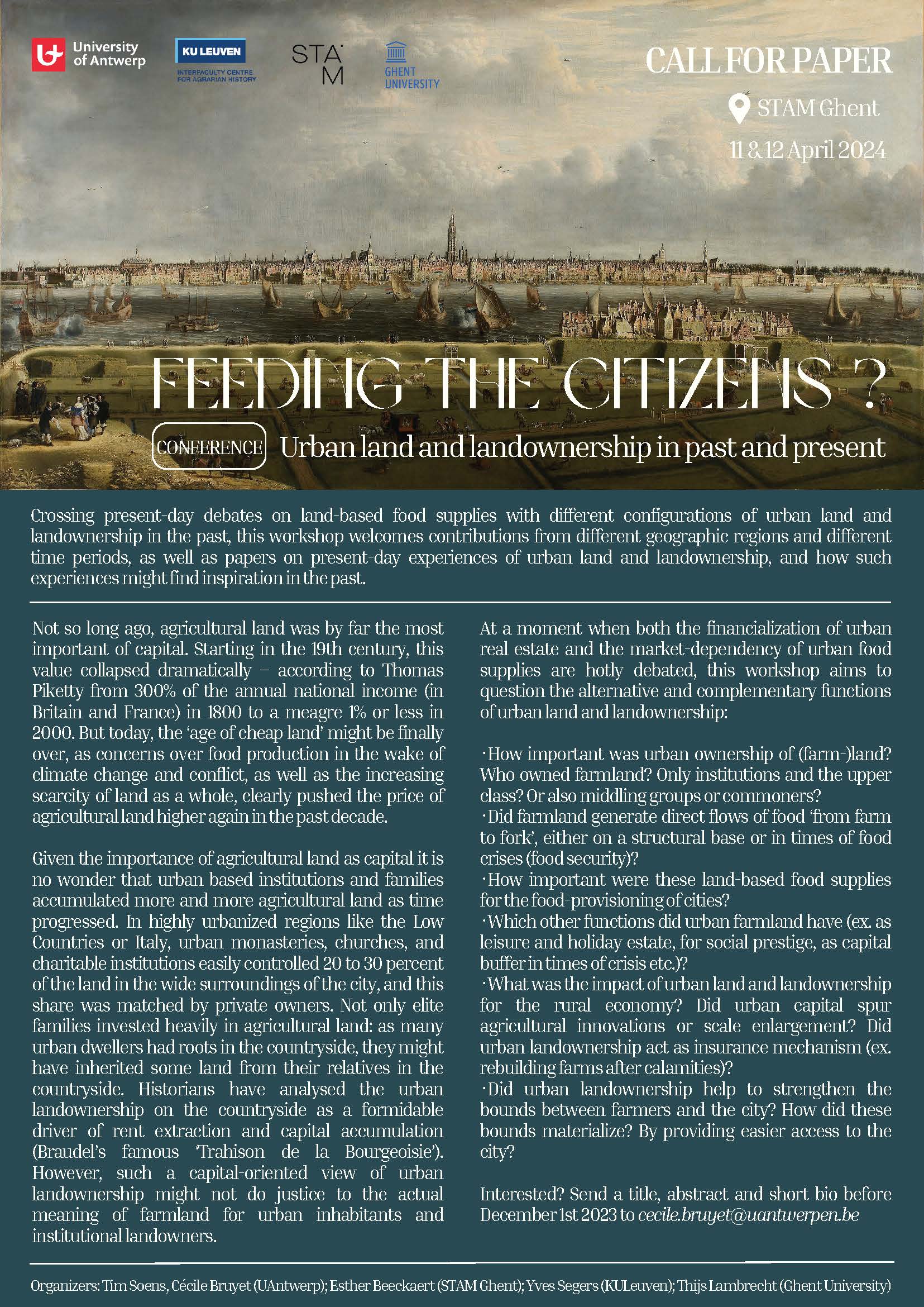
    On 11-12 April 2024, organisers Tim Soens, Cécile Bruyet (UAntwerp), Esther Beeckaert (STAM Ghent), Yves Segers (KULeuven), Thijs Lambrecht (Ghent University) welcome you at the conference ‘Feeding the Citizens? Urban land and landownership in past and present’, to be held at the premises of STAM Ghent City Museum.

    Crossing present-day debates on land-based food supplies with different configurations of urban land and landownership in the past, this workshop welcomes contributions from different geographic regions and differenttime periods, as well as papers on present-day experiences of urban land and landownership, and how suchexperiences might find inspiration in the past.

    For the full programme, please visit the conference website. Registration for non-presenting participants has opened now and is possible until 1 April 2024. Please note that a registration fee applies.

    MORE INFO

  • Book presentation ‘The World of Sugar’ by Ulbe Bosma

    Book presentation ‘The World of Sugar’ by Ulbe Bosma

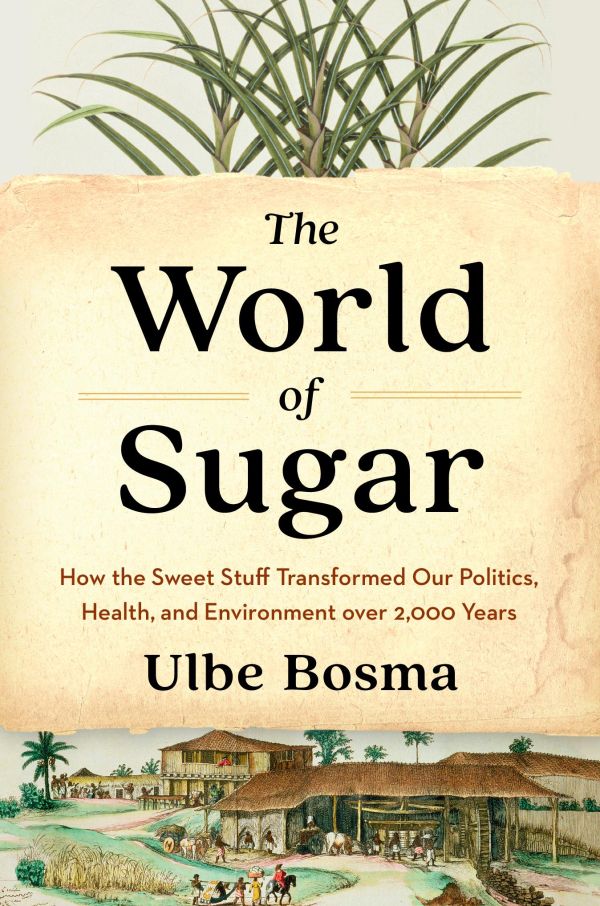
    The Food and Agricultural History Network recently hosted the book presentation of The World of Sugar. How the Sweet Stuff Transformed Our Politics, Health, and Environment over 2,000 Years (Harvard University Press, 2023), authored by Ulbe Bosma, board member of the N.W. Posthumus Institute and also one of the coordinators of our Research Network ‘Routes and Roots in Colonial and Global History’.

    In this global history, Bosma describes how sugar changed from being a luxury product in Asia to be present in most people’s diets worldwide, contributing to health crises and environmental devastation. The book starts with the earliest evidence of sugar production, leads the reader through the Middle Ages to the history of enslaved labour, and explores how sugar transformed life on every continent on political, cultural, economic and ecological levels.

    BOOK INFO

  • Middeleeuwen Symposium 2024: ‘Het onmisbare boek: handschriften en druk in de Late Middeleeuwen’

    Middeleeuwen Symposium 2024: ‘Het onmisbare boek: handschriften en druk in de Late Middeleeuwen’

    ~ because of scope in Dutch only ~

    Op 21 juni 2024 vindt in Zutphen het Middeleeuwen Symposium 2024 plaats. Dit symposium wordt gezamenlijk georganiseerd door De Librije Zutphen, de Historische Vereniging Zutphen, Erfgoedcentrum Zutphen en Musea Zutphen, in nauwe samenwerking met de Radboud Universiteit. Het thema dit jaar is ‘Het onmisbare boek: handschriften en druk in de Late Middeleeuwen’, dagvoorzitter is prof. dr. Johan Oosterman, hoogleraar Oudere Nederlandse letterkunde aan de Radboud Universiteit.

    Onderzoekers uit Nederland, België en Frankrijk vertellen over de sociaal-economische netwerken rond boeken, de diverse productiemethoden en -centra en de manier waarop schrijvers, drukkers en boekbezitters informatie probeerden te ordenen en ontsluiten. Op 20 juni 2021, daags voor het symposium, is tevens gelegenheid tot deelname aan excursies en het bijwonen van lezingen in de Collegetour.

    Voor deelname aan het Middeleeuwen Symposium 2024 en/of Collegetour geldt een bijdrage, voor studenten geldt een gereduceerd tarief.

    <a class=""bttn"" href=""” target=”_blank” rel=”noopener noreferrer”>MEER INFO

  • BREAKING NEWS: Posthumus moves from X (previously Twitter) to Mastodon

    BREAKING NEWS: Posthumus moves from X (previously Twitter) to Mastodon

    Follow us on Mastodon

    Recently, the N.W. Posthumus staff, supported by the General Board of the N.W. Posthumus Institute, has decided to stop using X, formerly known as Twitter, for new announcements. This decision has been made as a result of the current developments surrounding the X platform.

    As mentioned in our statement on social safety, we want our students, staff, and any other person or party involved with the N.W. Posthumus Institute to feel at ease, mutually respected, and included. This not only applies to our own events, but also extends to our online presence and use of social media. Also, we favour an open society with mutual respect to one another.

    Recent events have shown that the X platform repeatedly has fallen short in monitoring and responding adequately to messages of a discriminatory and/or offensive nature. The management of X has also shown not to be able to respond in a decent and respectable way in dealing with these events.

    These developments, in addition to the already previously implemented limitations in accessibility of the X platform have led us to believe that the use of this platform is no longer compatible with the norms and values supported by the N.W. Posthumus Institute. We therefore will stop using the platform actively, effective 1 March 2024. Our account will remain visible for some time for redirection purposes, but will not be used for active communication from our side.

    The N.W. Posthumus Institute will instead join the initiative supported by SURF and the Dutch universities to use the open-source social platform Mastodon as alternative to Twitter. This platform is server-based and moderated via the server owners, so not by a large commercial party. Joining the SURF-pilot allows us to start right away within a trusted and well-embedded logistic environment.

    We hope you do understand and respect our decision. Keep a close eye on the website and newsletter about any new developments and join us on Mastodon.

    Follow us on Mastodon

  • World Economic History Congress 2025 (Lund, Sweden)

    World Economic History Congress 2025 (Lund, Sweden)

    The theme for the 2025 World Economic History Congress (WEHC), to be held on 28 July-1 August 2025 in Lund, Sweden, is “Equality and Sustainability Challenges”. The WEHC is an international and interdisciplinary event, taking place every third year, placing economic history at its core. The congress appeals not only to economic historians but also to historians, political scientists, management scientists, sociologists, demographers, geographers, anthropologists, ethnographers, psychologists, philosophers, historians of science and technology, and natural and life scientists. Researchers from around the world are cordially invited to participate.

    The WEHC organisers call for session proposals addressing the theme of “Equality and Sustainability Challenges”. This theme underscores some of the pressing issues humanity faces today and draws connections to a diverse array of historical problems. To both understand and address these challenges, and to derive insights from the historical record, a range of perspectives is essential.

    Proposals should be submitted ultimately by 15 March 2024 (extended deadline) via the conference website.

    CONFERENCE WEBSITE

  • Introducing new Confidential Advisor Torsten Feys

    Introducing new Confidential Advisor Torsten Feys

    A few months ago, Heidi Deneweth announced her retirement, which also implied her farewell as Confidential Advisor (vertrouwenspersoon) for PhDs enrolled in the Posthumus PhD Training Programme. We thank Heidi very much for her conscious fulfillment of this position.

    We are happy to inform you that Torsten Feys, affiliated researcher at Flanders Marine Institute and Antwerp University has agreed to take over the position of Confidential Advisor in Flanders as of 1 March 2024. We thank Torsten for accepting this position.

    Torsten Feys works as of 2020 as research coordinator at the Flanders Marine Institute (VLIZ). His research focuses on tourism, migration and maritime history. He is also affiliated with the University of Antwerp as visiting professor. Torsten obtained his PhD from the European University Institute (Firenze) on a thesis on the Holland Amerika Lijn and the commercialisation of transatlantic migration (1830-1914). As a postdoc, he worked at Ghent University on the impact of transport companies on migration policies and at the Vrije Universiteit Brussel on the functioning of the Belgian foreigners’ police and its expulsion policies before 1914.

    As Confidential Advisors, both Torsten Feys and Elise van Nederveen Meerkerk (in the Netherlands) may be contacted by any Posthumus PhD candidate or (R)MA student who may have concerns or complaints about inappropriate behaviour within the context of Posthumus teaching activities. The confidential advisors will explore possible solutions together with you, and will point out appropriate institutional support if necessary. The advisors will also register complaints and report to the Executive Committee and the Scientific Director, so appropriate action can be taken. It goes without saying that every step in this process will occur in consultation with you and is based on anonymity. You can find more info on the website via the button below.

    MORE INFO ON CONFIDENTIAL ADVISORS
     
    PROFILE PAGE TORSTEN FEYS AT VLIZ