Research School for Economic and Social History

Blog

  • Talk and Film Screening on ‘Legacy and transitions: Rotterdam’s port in a global sustainability context’

    Talk and Film Screening on ‘Legacy and transitions: Rotterdam’s port in a global sustainability context’

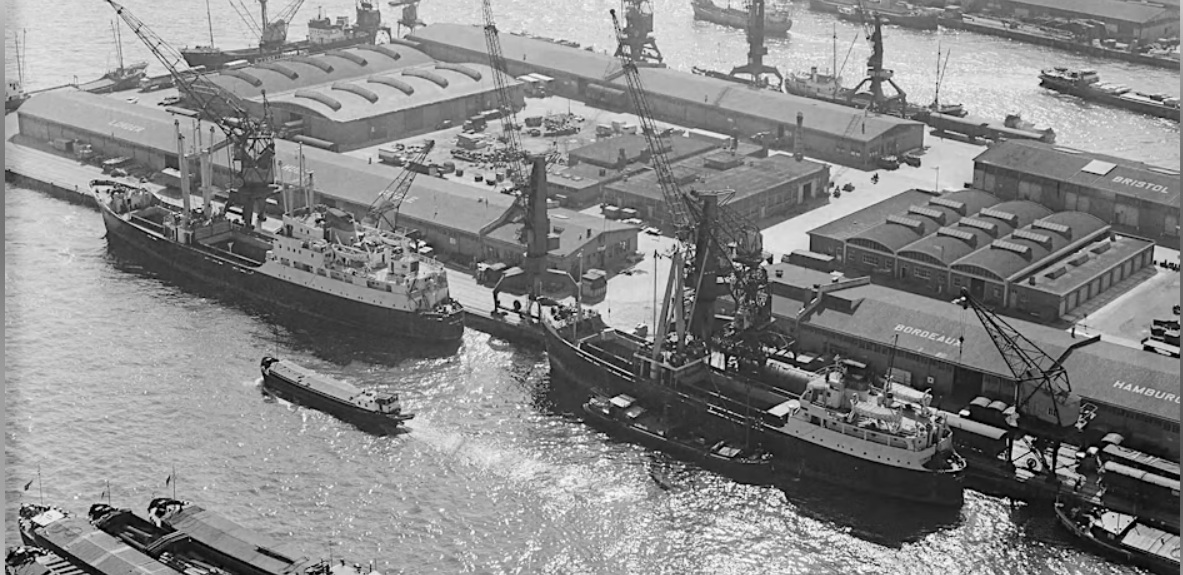
    On 2 June 2025, the Deep Transitions Lab (supported by UGlobe and the Strategic Theme Institutions for Open Societies of Utrecht University), organises an event on the theme ‘Legacy and transitions: Rotterdam’s port in a global sustainability context’, addressing both its history and the challenges it faces in transitioning to a sustainable port. The organisers seek to explore what this means for the Netherlands and, more broadly, how the impacts of local history on a global scale can be understood.

    The event will start off with a talk by Johan Schot, Professor of Global History and Sustainability Transitions at the Utrecht University Centre for Global Challenge, followed by a panel of interdisciplinary scholars:

    • Johan Schot, Professor of Global History and Sustainability Transitions, an historian on the port of Rotterdam with a focus on global sustainability transitions.
    • Jana Cox, Assistant Professor in Environmental Hydrology (Copernicus Institute of Sustainable Development, Utrecht University), researching the (interacting) influence of human interventions and climate change on estuaries and river deltas with a specific focus on the Rhine-Meuse.
    • Geert Buelens, professor of Modern Dutch Literature, researching cultural aspects of the Anthropocene and the Great Acceleration.

    The evening will be closes by a screening of the documentary Een kano naar zee, directed by Andre van der Hout (Dutch spoken, but subtitled in English).

    Participation in this event is free of charge, prior registration is however required.
    MORE INFO AND RESERVATION

  • Gerda Henkel Foundation awards grant to project ‘Economies of Trust’

    Gerda Henkel Foundation awards grant to project ‘Economies of Trust’

    The Gerda Henkel Foundation has awarded a grant of 253k euro to ‘Economies of Trust? A New Digital Infrastructure on the Urban Poor in the Cape Colony’.

    This project, administered by Radboud University, is a two-year project led by  Dr Dries Lyna (assistant professor at the Radboud Institute for Culture and History and member of the General Board of the N.W. Posthumus Institute and Principal Investigator of the ‘Economies of Trust’ project), Dr Eva Marie Lehner (postdoc researcher at the Bonn Centre for Slavery and Dependency Studies) and Dr Wouter Ryckbosch (assistant professor at Vrije Universiteit Brussel and also member of the General Board of the N.W. Posthumus Institute). The project will also involve three postdoc researchers, who will be recruited in the near future.

    This historical research project aims to construct and expand a digital infrastructure to facilitate future social and economic research regarding the eighteenth-century Cape Colony. The project also comprises a large outreach-component, aiming at art projects in cooperation with local museums and galleries (e.g., Iziko South African National Gallery en A4 Arts Foundation Cape Town), knowledge videos in cooperation with Blindspot Films Stellenbosch, as well as a community mapping-project with students from South-Africa in cooperation with the iDiscover company. The project is currently in the preparatory phase and will have its formal start in 2026.

    The N.W. Posthumus Institute congratulates Dries, Wouter, and Eva Marie with this grant.

    MORE INFO

  • Successful PhD Defence Posthumus alumnus Bas Spliet

    Successful PhD Defence Posthumus alumnus Bas Spliet

    On 14 May 2025, Posthumus alumnus Bart Spliet successfully defended the PhD thesis ‘The Demand of the Invisible Hand. The Consumer Revolution and Social Inequality in the (Pre)Modern Metropolis’ at the University of Antwerp. Supervisors were Professor Bruno Blondé (University of Antwerp) and Professor Wouter Ryckbosch (Vrije Universiteit Brussel).

    Bas’ dissertation confronts two schools of thought in the literature on social and economic history of northwestern Europe in the early modern era: the consumer revolution and social inequality. The first is grounded in research showing that the consumer patterns and material comfort of a growing share of the (urban) population in this region expanded in each subsequent generation during this transitional period. The second is less optimistic and with the observation of increasing income and wealth inequality strengthens the bleak image of low living standards in the centuries preceding the industrial revolution known from the literature on real wages. In this thesis, Bas Spliet analyses consumer developments in the most important commercial metropoles of the era: in the first place Amsterdam, but also Antwerp and London. In the final analysis, Bas Spliet re-establishes increased choice – first emphasised by Jan de Vries – as a core defining characteristic of nascent consumer societies. He argues that the consumer revolution was characterised by growing diversity and individuality as much as by increasing uniformity and persistent inequality. Both from the perspective of consumer agency and in the social spread of consumer goods, Bas concludes that the consumer revolution alleviated the social impact of augmented economic inequality – but only under the precondition of stable purchasing power.

    The N.W. Posthumus Institute staff congratulates Bas with this achievement!

  • Conference ‘How did we lift the burden? Infectious Disease Mortality in the Western and Non-Western World (1800-now)’

    Conference ‘How did we lift the burden? Infectious Disease Mortality in the Western and Non-Western World (1800-now)’

    On 28 and 29 August 2025, the researchers involved in COST-Action network GREATLEAP, in collaboration with the Radboud University Nijmegen, the HiDo network, and the IUSSP Panel ‘Epidemics and Contagious Diseases: The Legacy of the Past’, organise the conference ‘How did we lift the burden? Infectious Disease Mortality in the Western and Non-Western World (1800-now)’ . Keynote speaker at this conference is Professor Sheilagh Ogilvie (University of Oxford).

    The conference is not only a closing event of the NWO-funded research project ‘Lifting the burden of disease. The modernisation of health in the Netherlands: Amsterdam, 1854-1926‘, but it also marks the end of the academic career of Professor Angélique Janssens, who directed the aforementioned project. The conference will therefore be concluded by a farewell reception.

    Registration for the conference and/or the keynote is required.

    MORE INFO

  • Farewell event and reception Professor Angelique Janssens

    Farewell event and reception Professor Angelique Janssens

    On the occasion of her retirement, the Radboud Group for Historical Demography and Family History is hosting a farewell event and reception for Professor Angélique Janssens on 29 August 2025.

    Angélique Janssens is endowed Professor of Historical Demography at Radboud University Nijmegen. Her chair, located at Maastricht University, was devoted to topics relating to gender and labour. She is specialised in the history of mortality, medical history and causes of death. She was the principal investigator in three major project over the past years: the SHiP Project, the NWO project ‘Lifting the burden of disease’, and the Citizen Science project for the History of Health. She is also former Scientific Director of the N.W. Posthumus Institute.

    You are kindly invited to join the celebrations for her retirement. For catering purposes, prior registration is requested.

    Please note that this event will be preceded by the two-day symposium ‘How did we lift the burden? Infectious Disease Mortality in the Western and Non-Western World (1800-now)’ with a keynote lecture by Professor Sheilah Ogilvie (University of Oxford).

    The N.W. Posthumus Institute thanks Professor Janssens for the efforts made by her for the N.W. Posthumus Institute.

    REGISTRATION

  • Publicatie boek ‘Dievenland: overleven in de middeleeuwen’ van Posthumus fellow Janna Coomans

    Publicatie boek ‘Dievenland: overleven in de middeleeuwen’ van Posthumus fellow Janna Coomans

    ~ because of scope in Dutch only ~

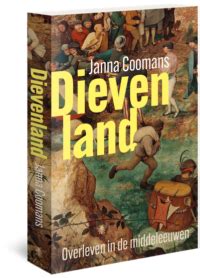
    Onlangs is bij Uitgeverij De Bezige Bij het boek Dievenland: overleven in de middeleeuwen van de hand van Janna Coomans, Posthumus fellow en coördinator van ons onderzoeksnetwerk ‘Economy and Society of the Pre-industrial Low Countries in Comparative Perspective’ verschenen.

    Op basis van tot nu toe onontdekte dievenbekentenissen verkent Janna Coomans de dagelijkse handel en wandel van de late middeleeuwen, waarmee dit boek een inkijk geeft in het leven van gewone mensen die geconfronteerd werden met instabiliteit en onzekerheid in de laatmiddeleeuwse Lage Landen.

    Het N.W. Posthumus Instituut feliciteert Janna met deze publicatie!

    WEBSITE UITGEVER

  • Posthumus board member Elise van Nederveen Meerkerk selected as new member KNAW

    Posthumus board member Elise van Nederveen Meerkerk selected as new member KNAW

    On its 217th anniversary, the Royal Netherlands Academy of Arts and Sciences (KNAW) has selected Professor Elise van Nederveen Meerkerk, also Board member of the N.W. Posthumus Institute, as new Academy member.

    KNAW Academy members are selected from a large number of nominations by expert juries in each scientific and scholarly field based on their excellent research combined with their importance in society as scientists.

    The KNAW states that Elise has been selected, because ‘Elise van Nederveen Meerkerk highlights the value of women’s work. Her research on topics including industry, sex work, and work in the home shows how crucial women have always been to the way society functions. Her focus is explicitly not limited to the Netherlands; she also positions her analyses in an international or colonial context. Van Nederveen Meerkerk works closely with researchers in other disciplines and ties in her historical research findings with contemporary social issues.’

    The formal installation of newly selected Academy members will be on 29 September 2025. The N.W. Posthumus Institute congratulates Elise with this appointment!

    MORE INFO

  • Pop-up Exposition and Conversation Piece – The Circle redrawn, Women at Work

    Pop-up Exposition and Conversation Piece – The Circle redrawn, Women at Work

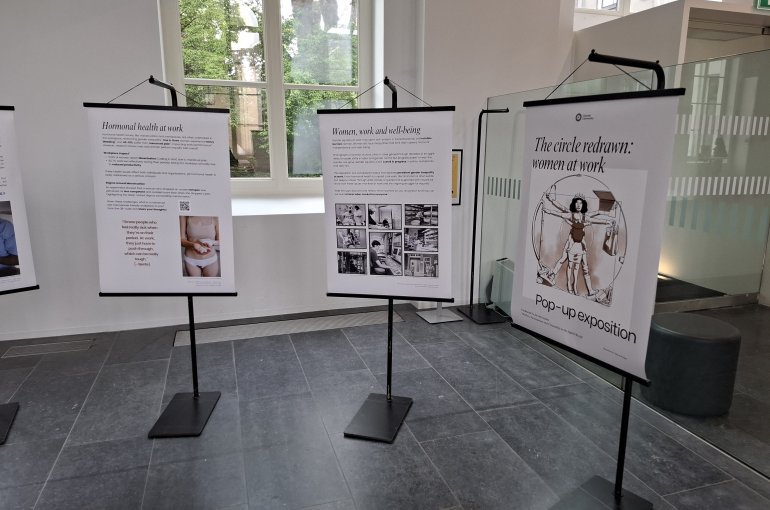
    From 7 until 22 May 2025, a temporary exhibition can be seen in the University Library at the Drift: The Circle redrawn, Women at Work.

    This exposition is organised by an interdisciplinary group of researchers (among whom Dr Sara Carmichael, substitute Board Member of the N.W. Posthumus Institute and Sophie Vries MA, participant of the 2024 cohort of the Posthumus PhD Training Programme), all with a passion for researching the theme ‘Women, Work, and Well-being’, approached from various scientific disciplines that they work in . The idea for this Pop-up Exposition and Conversation Piece, is to bring attention to the still ongoing gender inequality at work in an original and engaging way.

    The exposition brings together (historical) visual material, current research findings and personal quotes. It shows how gender, work, and well-being are closely linked and how this relationship is influenced not only by government policies, such as parental leave or childcare, but also by everyday social norms and expectations about gender roles. The central focus is on the challenges women face balancing work and well-being in today’s Dutch society. The Pop-up exposition also shows how many of these challenges, such as the division of care work, are rooted in historical developments and cultural norms. Themes such as hormonal dynamics, a structural blind spot in workplace contexts, and the mental load of both paid and unpaid work are made tangible through thought-provoking panels.

    This pop-up exposition is made possible by the sector plan “Welfare, Participation and Citizenship in the digital World.” Researchers and lecturers from four faculties at Utrecht University collaborate to expand these important themes in research, education and in dialogue between academia and practice. The exposition can be viewed during the opening hours of the Utrecht University Library City Centre.

  • Successful PhD Defence Posthumus alumna Tessa De Boer

    Successful PhD Defence Posthumus alumna Tessa De Boer

    On 7 May 2025 Posthumus alumna Tessa de Boer successfully defended the PhD thesis ‘A Truth Universally Acknowledged. Dutch Investment in French Colonial Resources in the Eighteenth Century’ at Leiden University. Supervisors were Professor Cátia Antunes (Leiden University) and Dr Elisabeth Heijmans (University of Antwerp).

    Tessa’s dissertation focuses on Dutch investments in the French colonial empire in the eighteenth century. During this period, the French empire was encapsulated by a strict framework of protectionist legislation (the Exclusif), aiming to reduce foreign interference in and dependence on foreign resources to operationalize the empire. In spite of this, business entities in the Dutch Republic were able to actively participate in the French colonial economy. Furthermore, Dutch-supplied credit played an important role in the financial circuits of the French empire. The dissertation analyses the commercial, political and social strategies that effectuated these investments. On a broader scale, these prominent investments in the ‘empire of another’ (in this case France) prove that the Dutch involvement in the colonial past goes beyond the Dutch colonies alone.

    The N.W. Posthumus Institute staff congratulates Tessa with her PhD!

  • Posthumus Conference 2025 – REGISTRATION NOW OPEN – keynote lecture by Professor Tamara Herzog (Harvard University)

    Posthumus Conference 2025 – REGISTRATION NOW OPEN – keynote lecture by Professor Tamara Herzog (Harvard University)

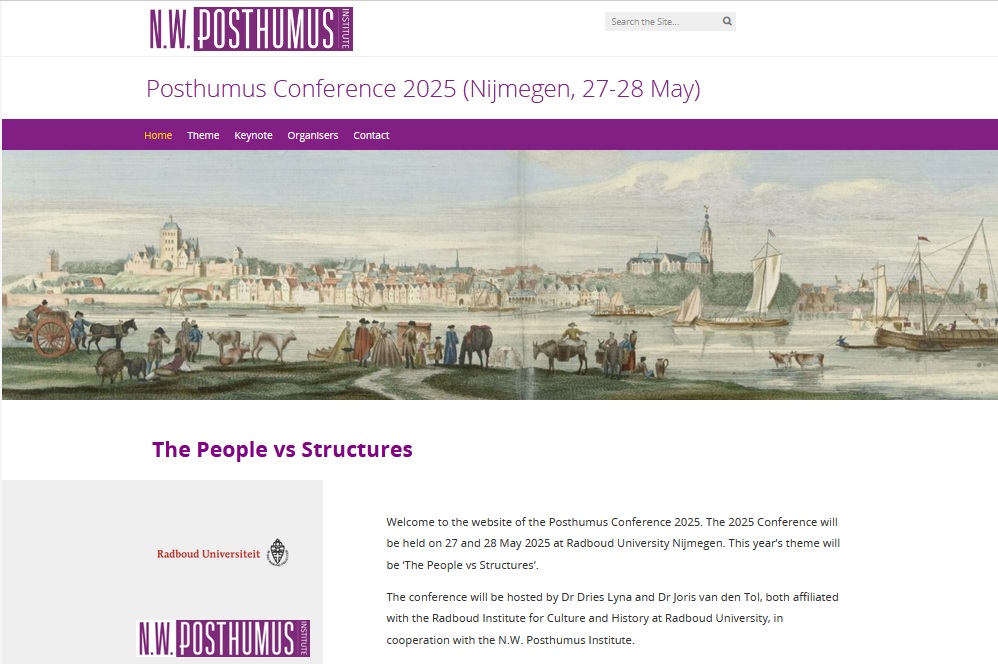
    We are happy to announce registration for the Posthumus Conference 2025 website is now open! On 27 and 28 May 2025, the Posthumus Conference 2025 will be held in Nijmegen at Radboud University, hosted by Dr Dries Lyna and Dr Joris van den Tol.

    This year’s conference will be on the central theme ‘The People vs Structures’: this theme allows a reflection on how legal systems, institutions, and practices have influenced social and economic conditions, as well as how people have influenced these legal regimes.

    The keynote lecture at the Posthumus Conference 2025 will be delivered by Professor Tamara Herzog, Monroe Gutman Professor of Latin American Affairs at Harvard University and Affiliate Professor of the Harvard Law School.

    The conference website will be regularly updated, so keep an eye on that website!

    CONFERENCE WEBSITE

    REGISTRATION FORM