Research School for Economic and Social History

Blog

  • UUCEMS Lecture 2025 by Professor Jake Soll – ‘Richard Price’s Prudence and the Unintentional Invention of Modern Capitalist Values’

    UUCEMS Lecture 2025 by Professor Jake Soll – ‘Richard Price’s Prudence and the Unintentional Invention of Modern Capitalist Values’

    On 15 May 2025, the Utrecht University Centre for Early Modern Studies (UUCEMS), in cooperation with Utrecht University’s Descartes Centre for the History and Philosophy of the Sciences and the Humanities organises its annual lecture. This year’s lecture will be delivered by Professor Jake Soll (University of Southern California) and is titled ‘Richard Price’s Prudence and the Unintentional Invention of Modern Capitalist Values (1758-1790)’.

    Historians have typically traced the tradition of Machiavellian Classical Republicanism as a political and moral movement opposed to commercial values. While recent research has shown pro-commercial strains of republicanism — in the Dutch Republic for example — Professor Soll’s presentation will show a more complex relationship between republican ideas of liberty and capitalist traditions. The example of Richard Price shows a remarkable attempt to use capitalism to create an innovative form of prudence to mitigate the dangers of finance and complex trade.  Paradoxically, by trying to balance greed and finance with accounting and probabilistic prudence, Richard Price helped build essential elements that would support the rise of financial capitalism.

    Attendance is free of charge, but prior registration is required; visit the lecture webpage via the button below for more info and the registration form.

    MORE INFO AND REGISTRATION

  • EUAH 2026 Conference ‘City Networks in Europe and Beyond’

    EUAH 2026 Conference ‘City Networks in Europe and Beyond’

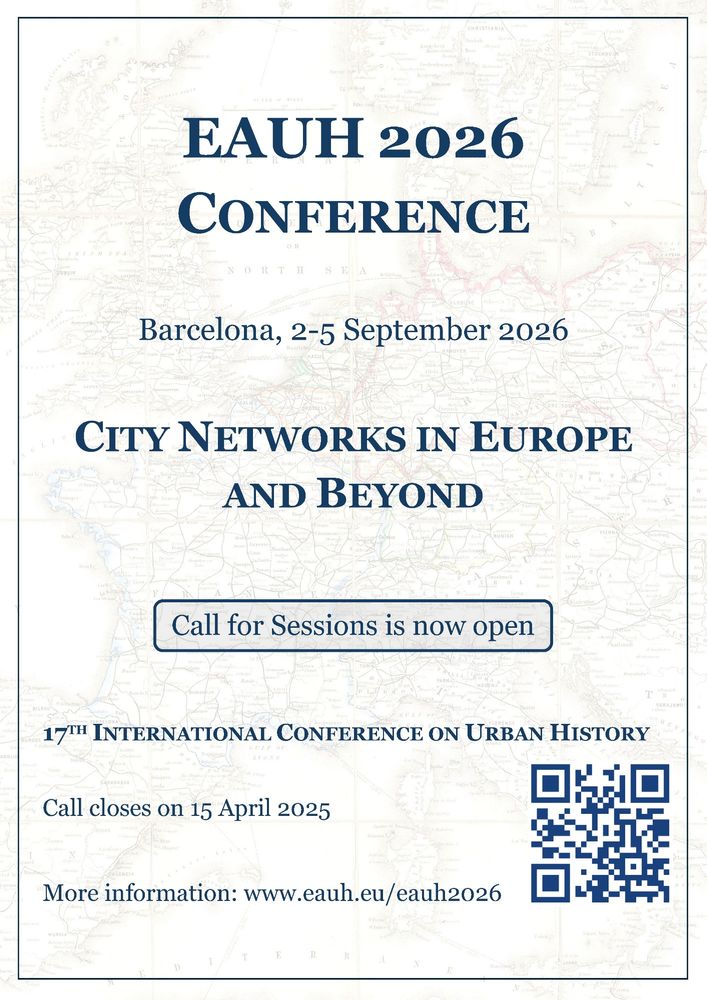
    The Seventeenth Conference of the European Association for Urban History (EAUH) will be held in Barcelona from Wednesday 2 September to Saturday 5 September 2026. The organisers welcome proposals for sessions for this conference edition; the central theme of the EAUH2026 Conference is ‘City Networks in Europe and Beyond’.

    With its focus on cities and the networked urban world, the Seventeenth EAUH Conference aims to foster cross-fertilisation between history, geography and other social and environmental sciences, all of which are critical sources of knowledge for the preservation of contemporary democratic culture.

    EAUH 2026 is hosted by the Facultat de Geografia i Història, University of Barcelona (UB), the Vallès School of Architecture (ESTAV) and the Centre de Cultura Contemporània de Barcelona (CCCB).

    Session proposals need to be based on the concept of an open call instead of  on the basis of a preconceived list of paper presenters. Proposals should be submitted ultimately 15 April 2025 via the dedicated Google Form. Specifications on how to submit and the link to the Google Form are to be found on the webpage of the EAUH2026 Conference (use the button below to visit that page).

    CONFERENCE WEBPAGE

  • Middeleeuwen Symposium 2025: ‘Oorlog en Vrede in de Middeleeuwen – Realiteit, Herinnering en Mythe’

    Middeleeuwen Symposium 2025: ‘Oorlog en Vrede in de Middeleeuwen – Realiteit, Herinnering en Mythe’

    ~ because of scope in Dutch only ~

    Op 20 juni 2025 vindt in Zutphen het Middeleeuwen Symposium 2025 plaats. Dit symposium wordt gezamenlijk georganiseerd door de Historische Vereniging Zutphen, Erfgoedcentrum Zutphen en Musea Zutphen, in nauwe samenwerking met de Radboud Universiteit en de Stichting Walburgiskerk. Het thema dit jaar is ‘Oorlog en Vrede in de Middeleeuwen – Realiteit, Herinnering en Mythe’, dagvoorzitter is prof. dr. Johan Oosterman, hoogleraar Oudere Nederlandse letterkunde aan de Radboud Universiteit.

    Het symposium besteedt aandacht aan recent onderzoek en richt zich op geschiedenisliefhebbers, professionals en studenten. De sprekers zijn werkzaam aan Nederlandse, Vlaamse en Britse universiteiten.

    Voor deelname aan het Middeleeuwen Symposium 2025 geldt een bijdrage, voor studenten geldt een gereduceerd tarief.

    MEER INFO

  • Conference ‘Women and the Household in the Early Modern Book Trade’

    Conference ‘Women and the Household in the Early Modern Book Trade’

    On 5-7 November 2025, the conference ‘The Women and the Household in the Early Modern Book Trade’ is jointly organised by the Museum Plantin-Moretus, University of Antwerp, KU Leuven, Utrecht University, and Northumbria University as part of the FWO research project ‘Partners in Innovation. Women Publishers as Knowledgeable Agents in the Low Countries’ Book Trade (1550-1750)’. The conference is also co-hosted by The Rubens House Museum in Antwerp.

    Keynote speakers at this conference are Professor Susan Broomhall (Australian Catholic University) and Professor Alicia Montoya (Radboud University).

    The organisers call for papers and invite participants to consider the supposed binary between home and work for women in the early modern book trade worldwide. Through this approach, the organisers hope to share knowledge of women’s rich and varied lives and works in the period before the rapid industrialisation of book production which changed the face of home labour for early modern women.

    Abstracts (max. 200 words) should be submitted via e-mail ultimately 31 March 2025. Specifications on how to submit are to be found in the full call via the button below.

    FULL CALL

  • PhD Defence Posthumus alumnus Jeroen van Veldhoven

    PhD Defence Posthumus alumnus Jeroen van Veldhoven

    On 7 March 2025, Posthumus alumnus Jeroen van Veldhoven successfully defended the PhD thesis ‘Partijpolitiek en de verschuiving naar flexwerk in Nederland’ [‘Party politics and the shift towards flexible work in the Netherlands’] at Utrecht University. Supervisors were Professor Lex Heerma van Voss (Utrecht University) and Dr Jeroen Touwen (Leiden University).

    The Dutch labour market has become increasingly divided between employees with permanent contracts and those on flexible contracts. In this dissertation, Jeroen examines how political choices have shaped this development. How have political parties and trade unions regulated these nonstandard employment contracts, and how can we explain their choices? Jeroen demonstrates that the second oil crisis in 1979 played a crucial role in shaping this trend. In response, employers looked for ways to save costs through flexible contracts. At the same time, many women entered the labour market. Due to caregiving responsibilities and limited work experience, they often ended up in these newly emerging flexible jobs.

    When inflation and unemployment led to new political ideas on regulation and deregulation, political support for stricter regulation of on-call work grew, while others pushed for the deregulation of protection of permanent employees’ labour contracts. The trade union movement opposed all forms of nonstandard employment.

    As left- and right-wing parties negotiated compromises on the Flexibility and Security Exchange (1996) and the Work and Security Act (2014), awareness of the downsides of the labour market division grew in the 2010s. This shift led to a stronger political focus on reducing the divide. Jeroen argues that this explains why even governments dominated by liberal parties eventually supported stricter regulations for nonstandard work, such as the Labour Market in Balance Act (2019).

    The defence ceremony will also be streamed live via the livestream of Utrecht University’s Senate Hall.

    The N.W. Posthumus staff congratulates Jeroen with this achievement!

  • Online Seminar: From Scribe to Screen: Sources and Approaches to Global History in the Digital Age

    Online Seminar: From Scribe to Screen: Sources and Approaches to Global History in the Digital Age

    Pichayapat Naisupap and Melinda Susanto (both Leiden University and Posthumus alumni) are co-organising the online seminar ‘From Scribe to Screen: Sources and Approaches to Global History in the Digital Age’.

    Digital humanities and the digitisation of archives are ever-growing trends in academia. How will digitisation open up new opportunities and yet present new challenges to historical research? Co-organised with Leiden University’s COGLOSS series, the GLOBALISE project — as well as projects associated with it (Combatting Bias and Necessary Reunions) — invites discussions on digitisation, accessibility, and new approaches to global history.

    The webinar starts with an introduction to GLOBALISE and its affiliated projects, followed by ‘lightning talks’, providing a platform for early career researchers to share their research and reflect on how digital methods have informed their work.

    Programme and speakers

    12:00-12:05 Pichayapat Naisupap (Leiden University) and Melinda Susanto (Leiden University & Huygens Institute) – Introductions
    12:05-12:10 Lodewijk Petram (Huygens Institute) – GLOBALISE
    12:10-12:20 Manjusha Kuruppath (Huygens Institute) and Leon van Wissen (University of Amsterdam) – Necessary Reunions
    12:20-12:35 Amber Zijlma and Mrinalini Luthra (both Huygens Institute) – Combatting Bias
    12:35-12:45 Q and A
    12:50-13:20 Lightning Talks
      Li Yichao (Peking University)
      Bart van Duijvenbode (Radboud University)
      Rosalie Oudshoorn (Leiden University)
      Satrio (Ody) Dwicahyo (Leiden University)
    13:20-13:30 Q and A

    Full info and registration

    You will find full details in the full call, to be downloaded as pdf below.
    Participation is free, but prior registration is required. A participation link will be sent to you after registration.

    FULL INFO (PDF)
     
    REGISTRATION FORM

  • PhD Defence Posthumus alumnus Dennis De Vriese

    PhD Defence Posthumus alumnus Dennis De Vriese

    On 10 March 2025, Posthumus alumnus Dennis De Vriese successfully defended the PhD thesis ‘Selling New Ways of Selling. Legitimising Regulation and Deregulation in the Brussels Meat Market (1770-1860)’ at the Vrije Universiteit Brussel. Supervisor was Professor Wouter Rykbosch.

    From the late eighteenth century, the rise of free-trade thinking and economic liberalism, alongside the political influence of the French Revolution, led to the dismantling of early modern economic regulatory frameworks across the Western urban world. While scholarship has examined ideological shifts among political elites and the immediate effects of deregulation, less is known about how these principles were implemented in everyday politics. In particular, little research has explored how radical transformations in market organization were legitimized and made acceptable to those directly affected, as such changes disrupted long-standing traditions, laws, and practices. This dissertation examines these dynamics through the case of the fresh meat trade in Brussels, a sector that played a crucial role in the broader liberalization of food markets.

    Meat, second only to bread in dietary significance, was considered suitable for free-market experiments. However, concerns over health risks led to a paradoxical situation in which slaughter was increasingly regulated while retail was liberalized. In Brussels, this process unfolded through successive waves of regulation and deregulation, as free-market ideologies clashed with a deeply rooted corporative regulatory tradition. This dissertation explores the rhetorical strategies employed by both regulators and butchers to shape, resist, or legitimize market reforms. It examines how market organization was framed within shared conventions to persuade political peers, sway lawmakers, and gain public legitimacy.

    The findings challenge the assumption that deregulation led to a simple transfer of responsibility from government to consumers. Instead, both supporters and opponents of regulation framed their arguments in terms of consumer interest. However, within this shared rhetoric, actors had considerable leeway in defining key concepts, particularly competition, which became a central point of contention. Butchers and regulators used competing interpretations of how competition functioned, how it should be promoted, and its effects on market stability to justify their positions—sometimes invoking the same principles to support opposing arguments. This flexibility allowed butchers to resist or advocate for reforms while aligning their claims with broader liberal economic ideals.

    Despite the increasing dominance of free-market ideology, municipal authorities continued to exert indirect influence over the meat trade. They used tools such as tax policies, fines for tax evasion, and cattle competitions to shape market behavior while maintaining the appearance of market liberalism. These interventions were justified through the same discourse that had originally supported retail liberalization—ensuring cheap and safe meat for consumers. This rhetorical continuity allowed policymakers to present regulatory shifts as consistent with longstanding objectives, even as their approach fluctuated between market control and liberalization.

    Butchers, in turn, adapted to deregulation by expanding their retail presence across the city, aligning their practices with consumer demand and intensifying price competition. Their spatial distribution after the 1840s reflected principles of central place theory, reinforcing the notion that liberalized markets naturally benefited consumers. Dennis’ study reveals how a semi-flexible discourse—rooted in enduring economic goals but adaptable in its application—played a functional role in legitimizing regulatory transformation. By embedding new practices within familiar rhetorical frameworks, this discourse facilitated the transition to modern market structures while maintaining continuity with past traditions.

    The N.W. Posthumus Institute congratulates Dennis with this achievement!

  • Wieke Metzlar winner of Volkskrant-IISG History Thesis Award

    Wieke Metzlar winner of Volkskrant-IISG History Thesis Award

    Wieke Metzlar, member of the 2024 PhD cohort of the N.W. Posthumus Institute, has won the Volkskrant-IISG History Thesis Award. The Volkskrant-IISG Thesis Award is annually awarded to the best history-related Master’s thesis in the Netherlands.

    In the Master’s thesis, Wieke researched causes for excessive mortality rates in girls compared to boys in 19th-century Maastricht. Strikingly, the conclusion was that girls were more at risk than boys. Wieke’s research showed that girls often resided indoors, exposing them to worse hygienic conditions and illness due to having to care for sick family members, leading to an elevated risk of mortality.

    The judges praised Wieke’s thesis for its careful approach and its societal relevance, showinghow historical research can help to better understand gender-related health disparities.

    The N.W. Posthumus Institute congratulates Wieke with this award!

    NEWS ITEM RADBOUD UNIVERSITY
     
    NEWS ITEM VOLKSKRANT (IN DUTCH, SUBSCRIPTION REQUIRED)

  • VICI Grant awarded to Elise van Nederveen Meerkerk

    VICI Grant awarded to Elise van Nederveen Meerkerk

    The Dutch Research Council (NWO) has awarded Elise van Nederveen Meerkerk, member of the General Board of the N.W. Posthumus Institute, a VICI Grant for her research project ‘Care and Coercion. Patriarchy, (Forced) Labour and Caregiving in the Household in the Dutch Empire, c. 1750-Present’.

    Around the world, domestic and caregiving work are highly gendered as well as racialised. This research project aims to study the historical roots of these entangled inequalities, by looking at how forms of care and coercion interacted at the intimate level of the household. The project concentrates on four interrelated regions in the (former) Dutch empire, in which various forms of forced labour ranging from slavery to more informal forms of coercion existed. It compares regions on four different continents and over time, thus connecting metropole and colonies as well as colonial and postcolonial developments.

    The N.W. Posthumus Institute congratulates Elise with this awarded grant!

    Photo: (c) Ed van Rijswijk

    NEWS ITEM UTRECHT UNIVERSITY

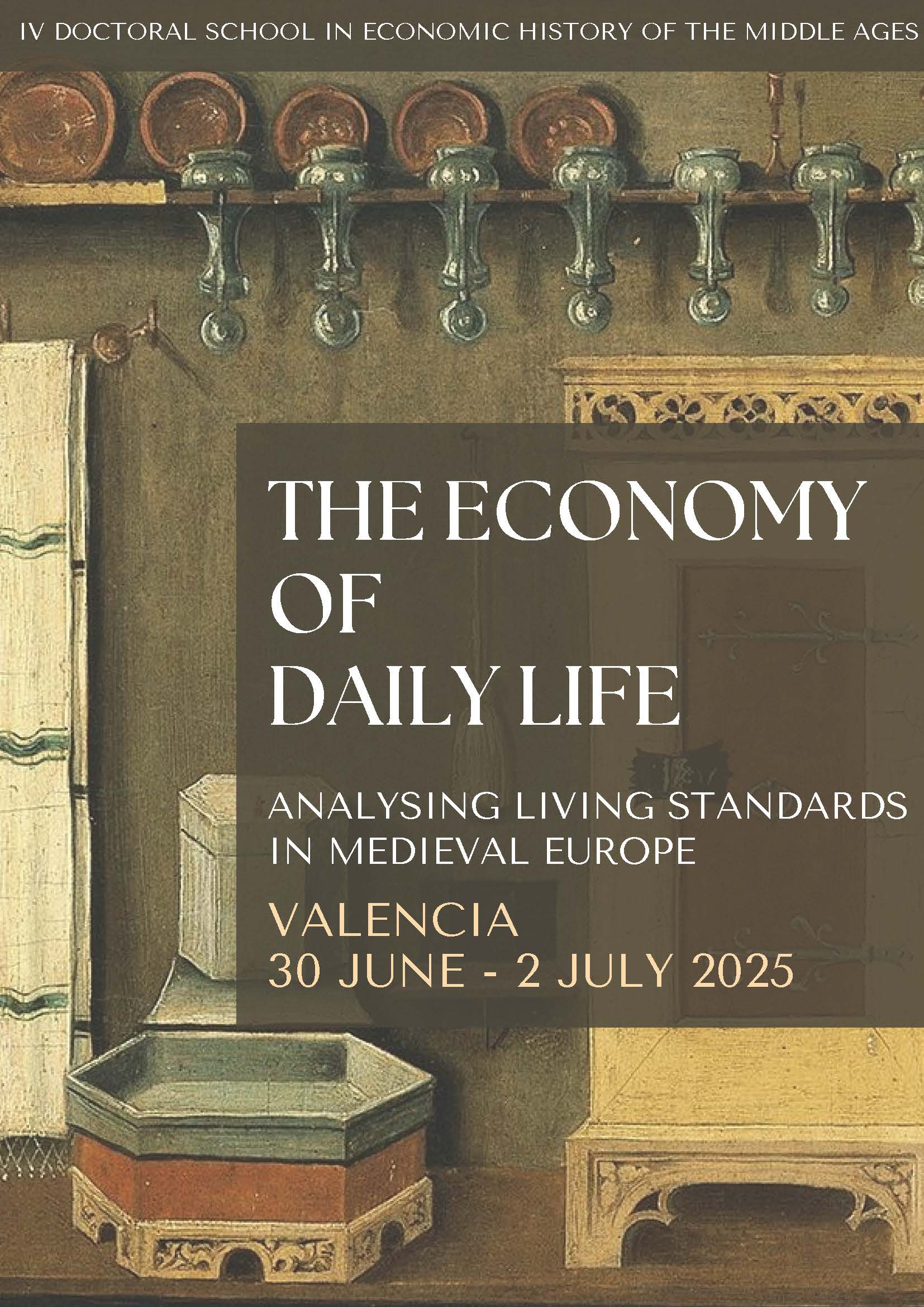
  • IV Doctoral School in Economic History of the Middle Ages ‘The Economy of Daily Life: Analysing Living Standards in Medieval Europe’ (University of Valencia)

    IV Doctoral School in Economic History of the Middle Ages ‘The Economy of Daily Life: Analysing Living Standards in Medieval Europe’ (University of Valencia)

    The research group Cultures i Societats de l’Edat Mitjana (CiSEM) at the University of Valencia is organising the IV Doctoral School in Economic History of the Middle Ages, to be held from 30 June to 2 July 2025, which will be dedicated to ‘The Economy of Daily Life: Analysing Living Standards in Medieval Europe’.

    This Doctoral School will address the latest research on living standards, with a particular focus on training doctoral students and early-career researchers in theoretical and methodological aspects. Papers and presentations will be the essential means to understand living standards and the socio-economic complexities of the medieval population, offering a more comprehensive view of how these aspects were intrinsically linked to daily life and social structures.

    To highlight the wide range of available sources and methodological approaches on the subject, the Doctoral School will feature internationally renowned scholars delivering keynote lectures. This will be followed by presentations by doctoral students and early-career researchers. The three invited professors are Robert Allen (New York University Abu Dhabi & University of Oxford), Posthumus fellow Alexandra de Pleijt (Wageningen University & Research), and Lluís To (University of Girona). In addition, senior professors and researchers from various Spanish universities involved in the School’s activities will also participate.

    The organisers encourage doctoral students and early-career researchers interested in the topic to submit their proposals. Submissions should be sent by 30 April 2025; further specifications are to be found in the full call via the button below.

    FULL CALL (PDF)